
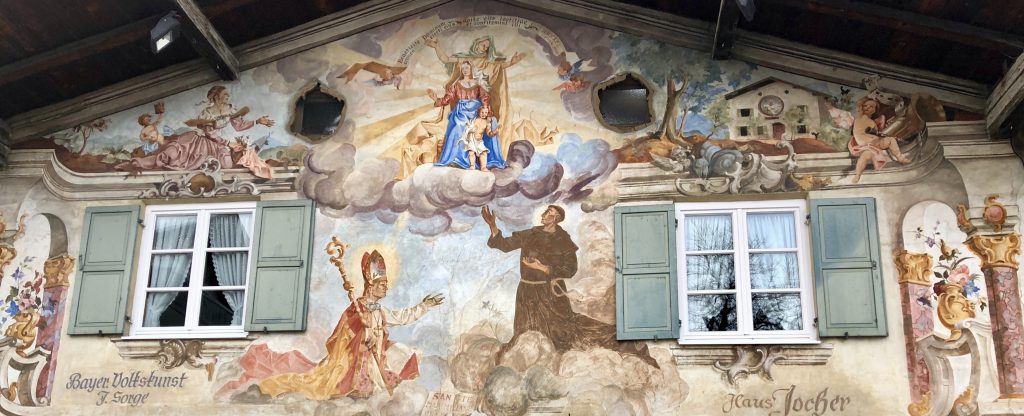
Lüftlmalerei ARTISTS

“There really is no such thing as Art. There are only artists.”

– Ernst Hans Josef Gombrich, The Story of Art

Heinrich Bickel

Heinrich Bickel, “The Fresco Painter from Werdenfels,” was born on January 27, 1897, in Pappenheim an der Altmühl, the son of a decorative painter.

The Bickel family moved to Garmisch-Partenkirchen in 1913.

When World War I broke out in 1914, Heinrich Bickel — at the age of seventeen — volunteered for the front line.

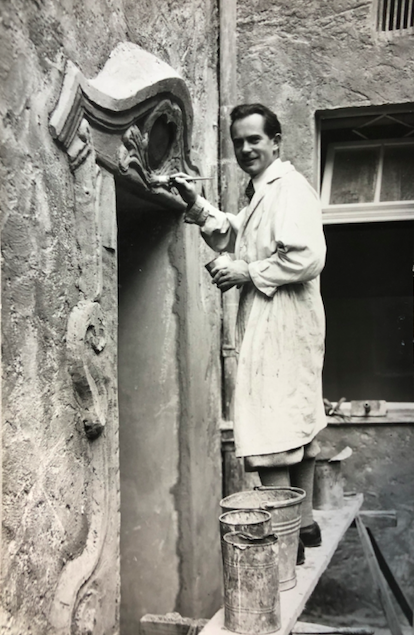
1926/27 photo of the artist from the Markt Archiv Ga-Pa, Depositum Heinrich Bickel.

After returning home, unharmed, the young Bickel learned his father’s profession and passed the journeyman’s and master’s degrees in painting.

In order to continue his education, the budding artist undertook numerous study trips through Italy and Spain.  It was on these journeys that Heinrich Bickel learned the specific technique of fresco painting.  Moreover, he learned and would later incorporate the use of sgraffito in his murals in his works.

His career as a Lüftl painter began with a freelance order for a fresco on the outside of an old farm house on Ludwigstraße, “Das Altes Haus,” in 1921. 

According to an August 25, 1952, Time Magazine article1:

A stocky, dedicated little artist with an iron-grey mustache and invariably dressed in traditional Bavarian leather shorts, Bickel took up wall-painting when an antique dealer gave him the job of repainting a house to make it look old. In an 18th century manuscript, Bickel found a formula for fresco painting: mortar made half & half of fine sand and chalk, laid on while wet with five simple "earth" colors. Taking his style from the baroque masters (because they specialized in "free and large" art), he achieved such appealing results that he has been swamped with commissions ever since".

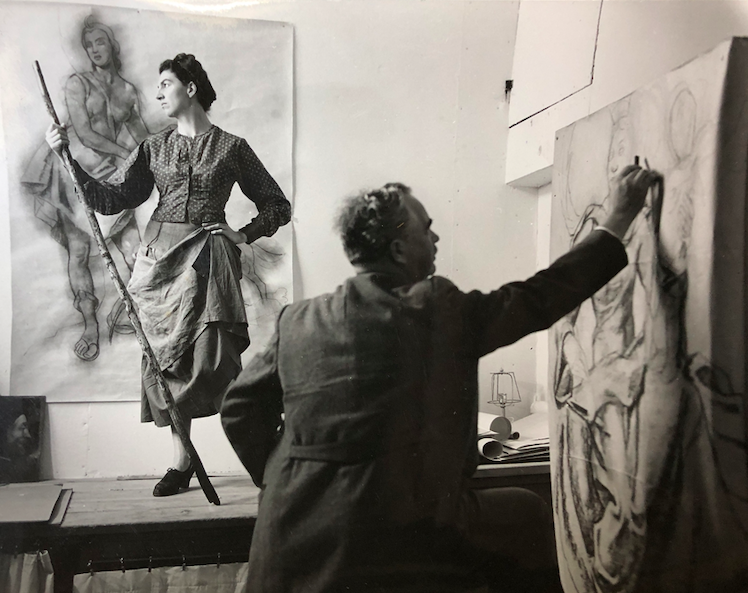
Undated photo of the artist from the Markt Archiv Ga-Pa, Depositum Heinrich Bickel.
Photo of the artist "um 1950" from the Markt Archiv Ga-Pa, Depositum Heinrich Bickel.
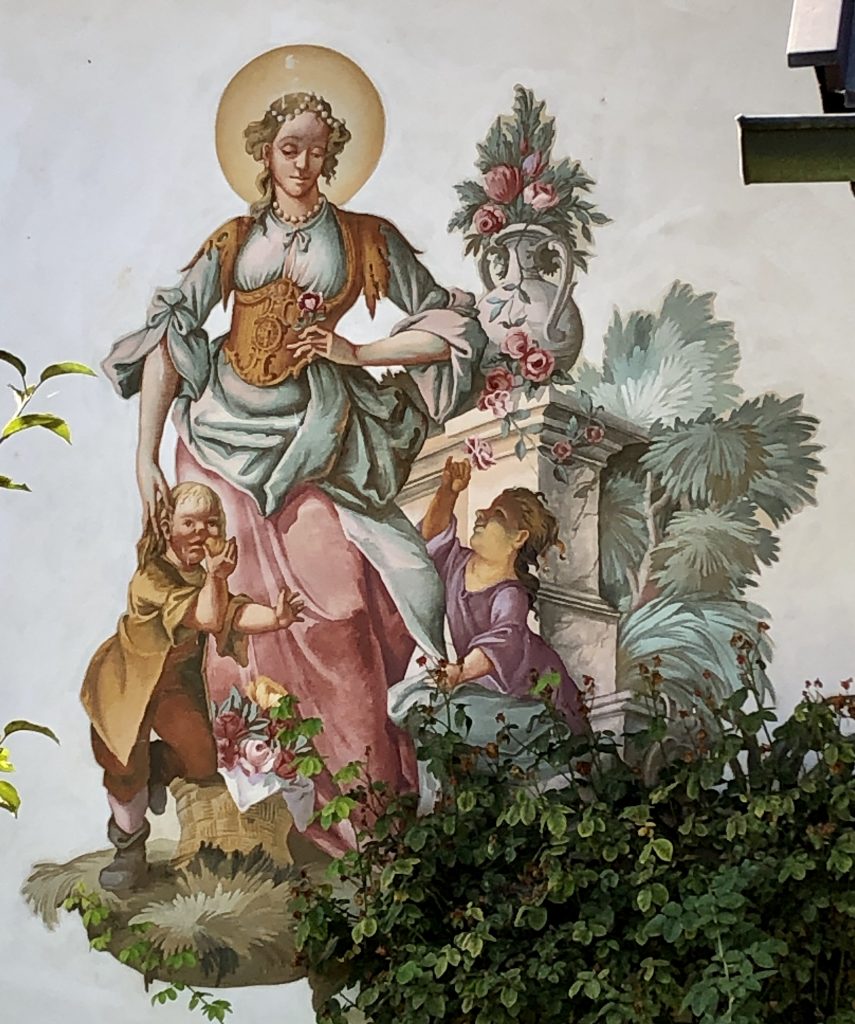
Undated photo of the artist from the Markt Archiv Ga-Pa, Depositum Heinrich Bickel.

From then on, Heinrich Bickel worked as a fresco and house painter in the Werdenfels region for over 40 years.

Few lüftlmalerei artists were as prolific in Garmisch-Partenkirchen as Bickel, and few managed to conjure up such imaginative, lively scenes.

According to the authors of Lüftlmalerei an Isar, Partnach, Loisach und Ammer (2003), during the Second World War, Bickel fulfilled his military service obligation in Burghausen.  According to the authors of Heinrich Bickel – Der Freskenmaler von Werdenfels (1990), during the war, shell fragments injured his left hand, and he lost some eyesight due to gas poisoning.

However, between 1934 and 1945, his art adorned new government buildings in Garmisch-Partenkirchen — such as the newly consolidated town’s town hall and adjacent buildings in 1934 at what is now called Rathausplatz, and the reserve hospital on Lazarettstraße, built between 1938 and 1942. 

Bickel’s most intensive creative phase was the time after the Second World War, however, when leaned in to the whimsical Baroque and Rococo styles much more than before. His idealized portrayal of local farmers, hunters and raftsmen, reminiscent of artist Albin Egger-Lienz’s, disappeared, giving way to a more popular, narrative style.

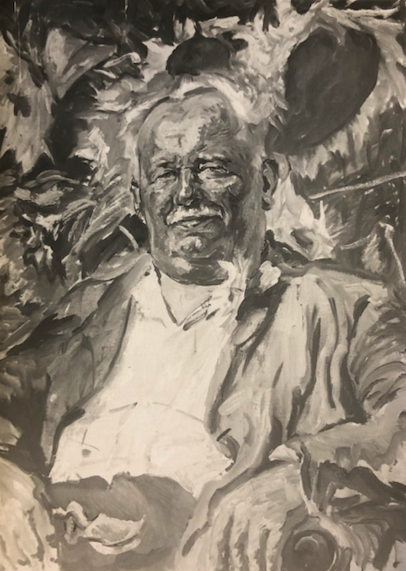
Undated photo of a portrait of the artist from the Markt Archiv Ga-Pa, Depositum Heinrich Bickel.

His daughter, Moidele, worked with him, and completed some lüftlmalerei around the town near the end of his life.

On February 2, 1965, Heinrich Bickel died of kidney disease in his home.

Moidele Bickel

Maria “Moidele” Bickel, celebrated local artist Heinrich Bickel’s daughter, was born in Munich on March 6, 1937.

According to Moidele Bickel, she never finished high school. She reportedly said to her father one day, “these nuns, they are too stupid, I can’t stand it anymore,” and dropped out, opting instead to work with him painting house facades.2

She described her art as like her father’s — and unlike it.  “Of course,” she explained in one interview, “I didn’t want to do it the way he did.  I wanted to do it completely differently.”3

In the 1950s, she studied painting at the Munich Academy with Josef Oberberger.4  It was then she first attended and fell in love with the theater.  Believing stage design was her future, she went to Professor Helmut Jürgens, who taught stage design at the Academy. She later recounted that he told her to “go back to your father, at least you will earn money.”5

The origin of her theater career actually began exactly because of her work with her father.  After the two worked together to renovate the Prince-Bishop’s Opera House in Passau, from 1959 to 1961,6  Moidele Bickel asked the theater director if she could stay.7  As a result, she found work as a stage designer in Passau and Landshut.8 She worked mostly as a screen set and backdrop painter for small theater groups.9

Bickel began her career as a costume designer at the Theater am Turm in Frankfurt in 1968. In 1970, when Bickel heard that director Peter Stein — whom she knew from their student days in Munich — was working at the Schaubühne, she moved to Berlin.10  She worked there as a costumer for 22 years,11 then as a freelance designer.

Her designs for “The Marquise of O.” (1976) won her a British Academy Award (BAFTA). She won the César in France in 1995 for “La Reine Margot” (“Bartholomäusnacht” in Germany), for which she was also nominated for an Academy Award (an Oscar).12  Her work on the costumes for “Das weiße Band” helped the film to win the film the Palme d’Or at the Cannes Film Festival in 2009.

(While a number of Moidele Bickel’s online obituaries mention that she was known and had been awarded the 1993 César for her costuming work on the film “Germinal” under the pseudonym “Bridgette Villard” — for instance, on IMDb.com and Wikipedia.org —  THE Bridgette Villard told me SHE actually won the César for her costume work on the film “Germinal” in 1993, and reminded me not to believe everything I read online.13)

Moidele Bickel died at the age of 79 on May 16, 2016, in Berlin.14

Christa Burges

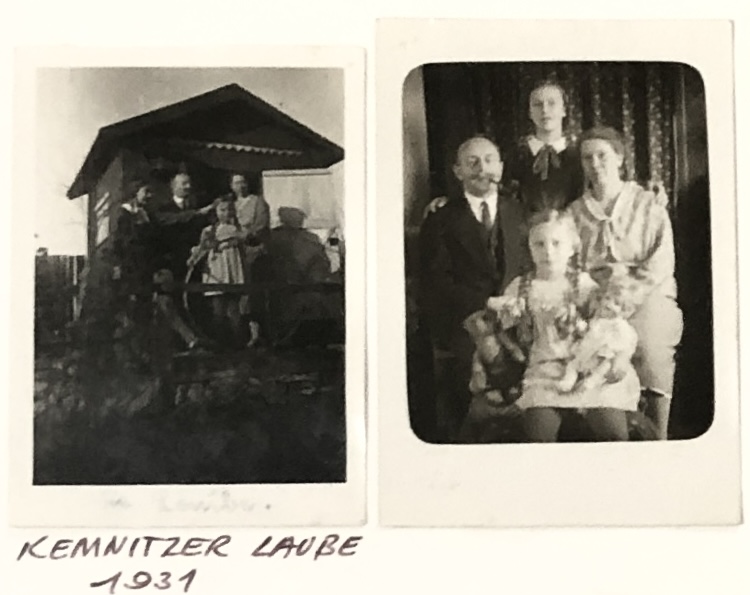
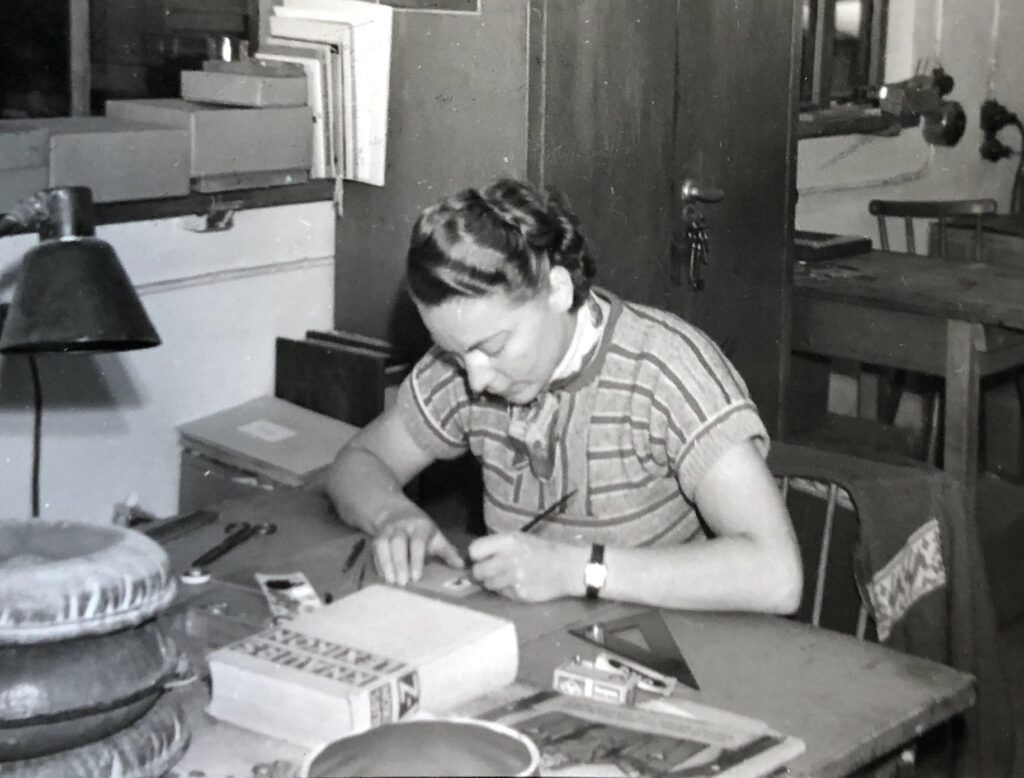
1931 photos of the artist from the Markt Archiv Ga-Pa, Depositum Christa Burges

Christa Burges was born in Dresden on July 14, 1924, to a family of Huguenot descent.

From 1941 to 1945 she studied at the Staatliche Akademie der Bildenden Künste, Dresden: first graphic art and illustration with Max Claus, then portrait and easel painting with Georg Siebert (from October 1942) and finally composition, mural and easel painting in Hans Hanner’s master-class, where she was accepted as Meisterschülerin and won the Academy prizes of 1942 and 1944.15

Between February 13 and February 15, 1945, Allied Forces in World War II dropped so many bombs on Dresden, that some 25,000–35,000 civilians were killed and the city was nearly completely destroyed.

Burges survived the bombing, and in March 1945, she moved to Garmisch-Partenkirchen — the town where she made her home.16

After the War, she worked carving toys and making silhouettes, then as a commercial graphic designer. 

For the next 43 years she remained a freelance painter, draughtswoman, muralist, linocut and wood-cut print-maker, and wood-relief carver.

She won international competitions for her designs of coins, medals, and plaques,17 and also did book illustrations and cover designs, such as for the 1963 book Prinzessin Attaleia : Ein Märchen für Kinder by Nelly Louise Brandenburg,18 and for the 1986 anthology Zur Geschichte der Kinderklinik und Rheumakinderklinik in Garmisch-Partenkirchen 1932–1986.19

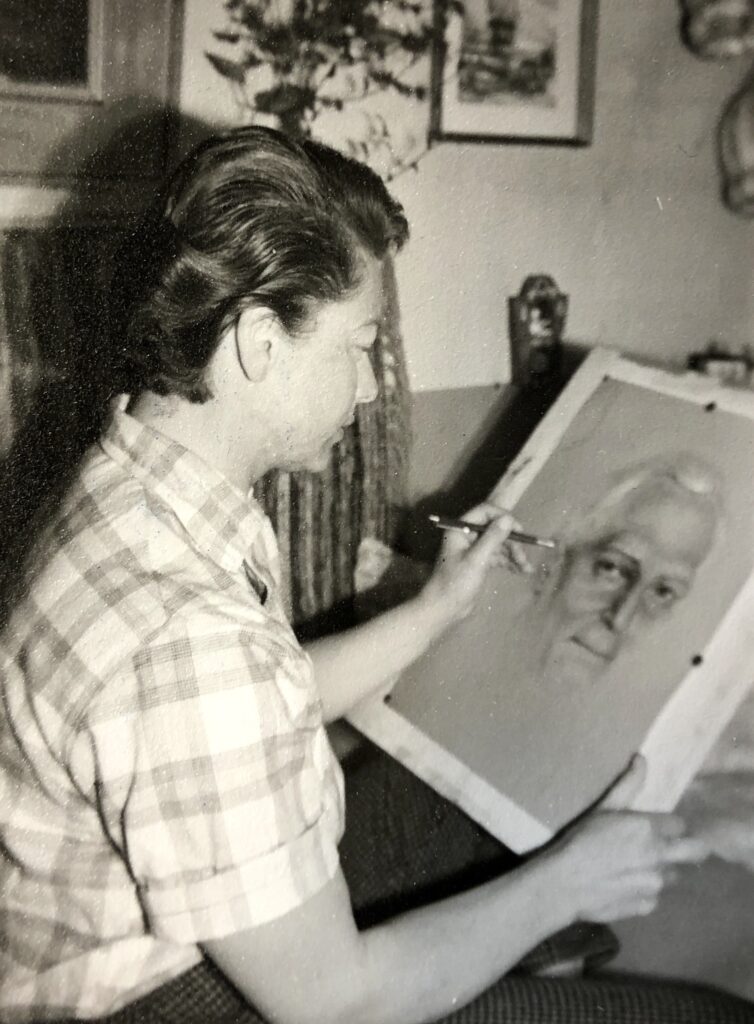
Undated photo of the artist from the Markt Archiv Ga-Pa, Depositum Christa Burges

Teaching became her second vocation. She began running art and craft courses at the local adult-education centre (Volkshochschule) in 1967, and remained its longest-serving tutor.

In 1985 she assumed the chair of the Werdenfelser Künstlerbund, which in 1986 became the Werdenfelser Künstlergilde, and she founded the private Kunst-Seminar Werdenfels.20

Markt Archiv Ga-Pa, Depositum Christa Burges, 1375
Markt Archiv Ga-Pa, Depositum Christa Burges, 1495
Markt Archiv Ga-Pa, Depositum Christa Burges, 1492

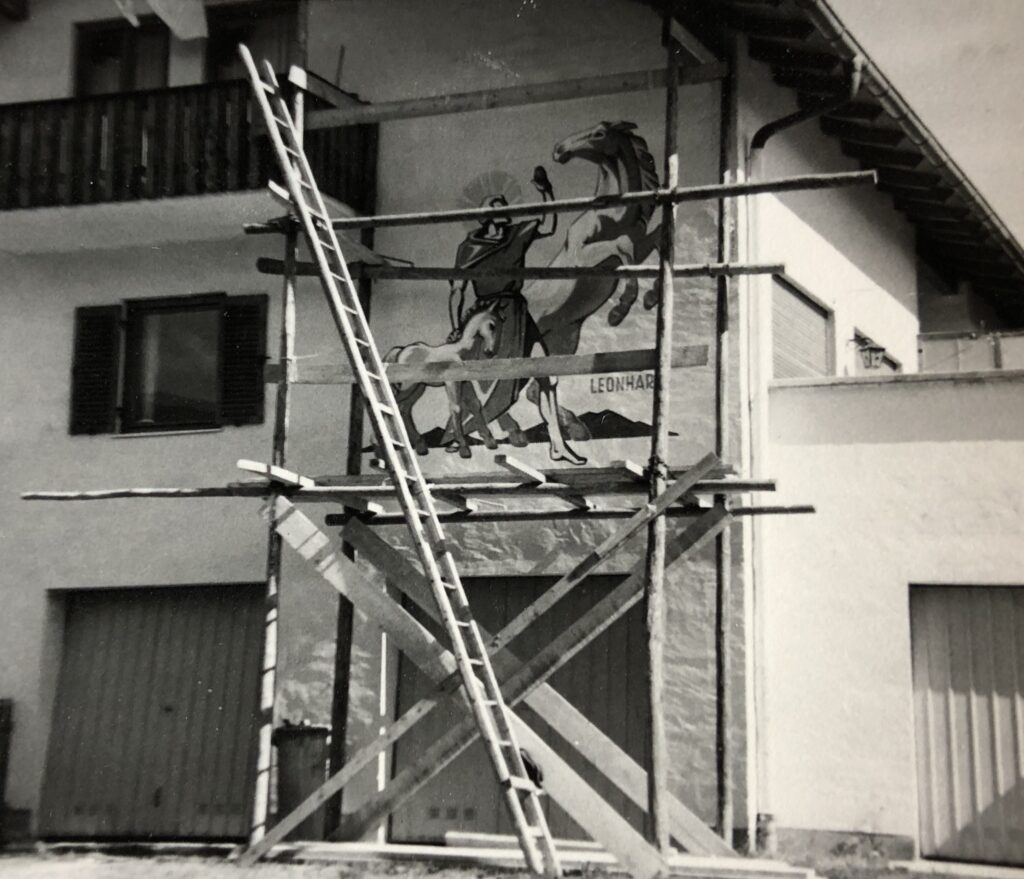
Burges painted a number of Lüftlmalerei in the Garmisch-Partenkirchen area:

  • Garmisch-Partenkirchen im Jahreslauf, Alpspitz-Wellenbad (1955) – her first large-scale commission.
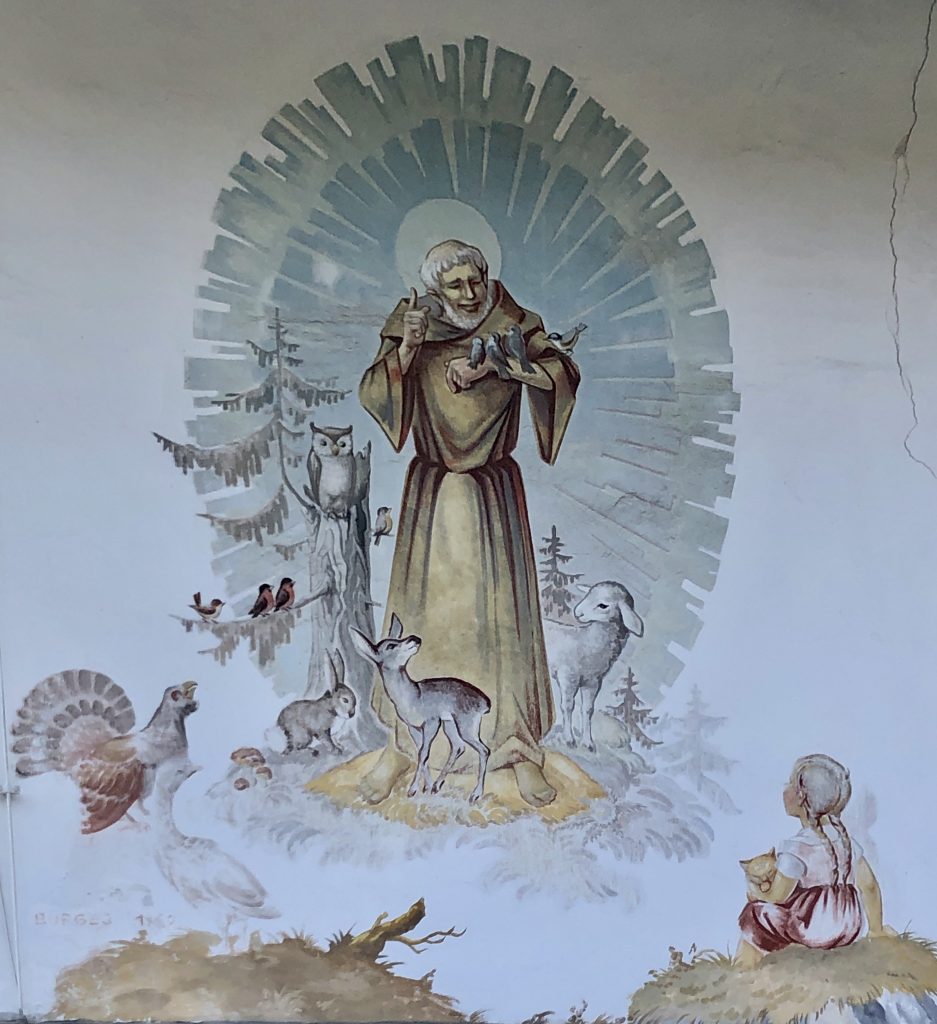
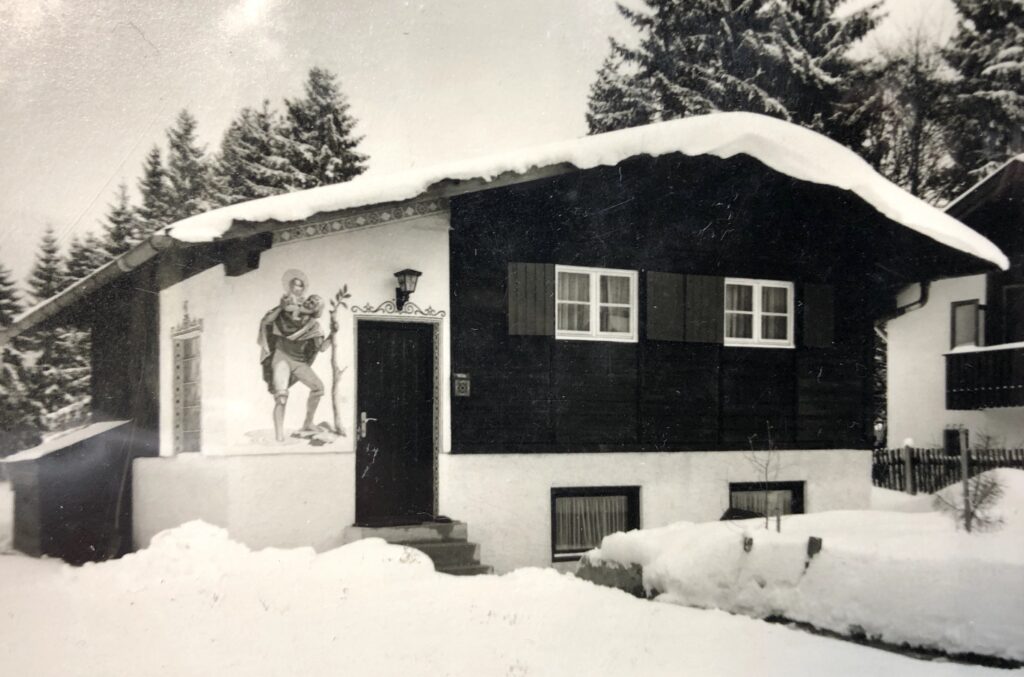
  • Saint Christopher on the front of of her own home at Fichtackerstraße 23 (1971).
  • Paired murals Berge (valley station) and Saint Bernard (summit station) for the Osterfelder cable-car (1973).
  • A mural combining a Resurrection scene with a plea against violence in the NATO School chapel in Oberammergau (1973).
  • An athletics frieze for the Gröben primary school and new sports centre (1977).

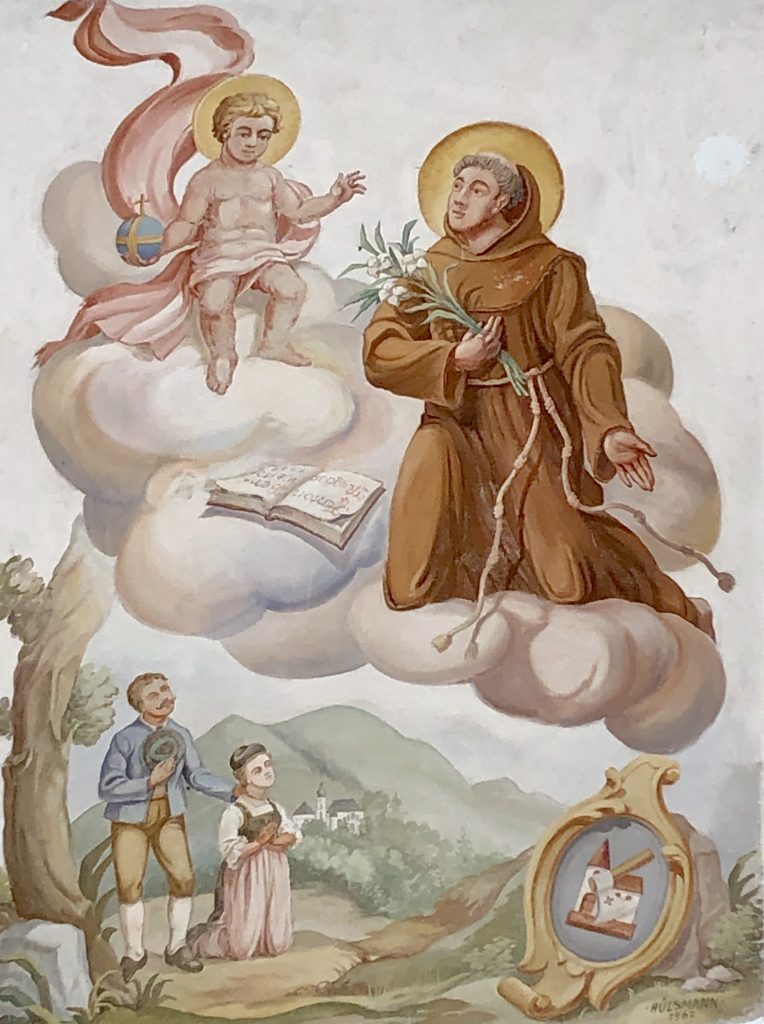
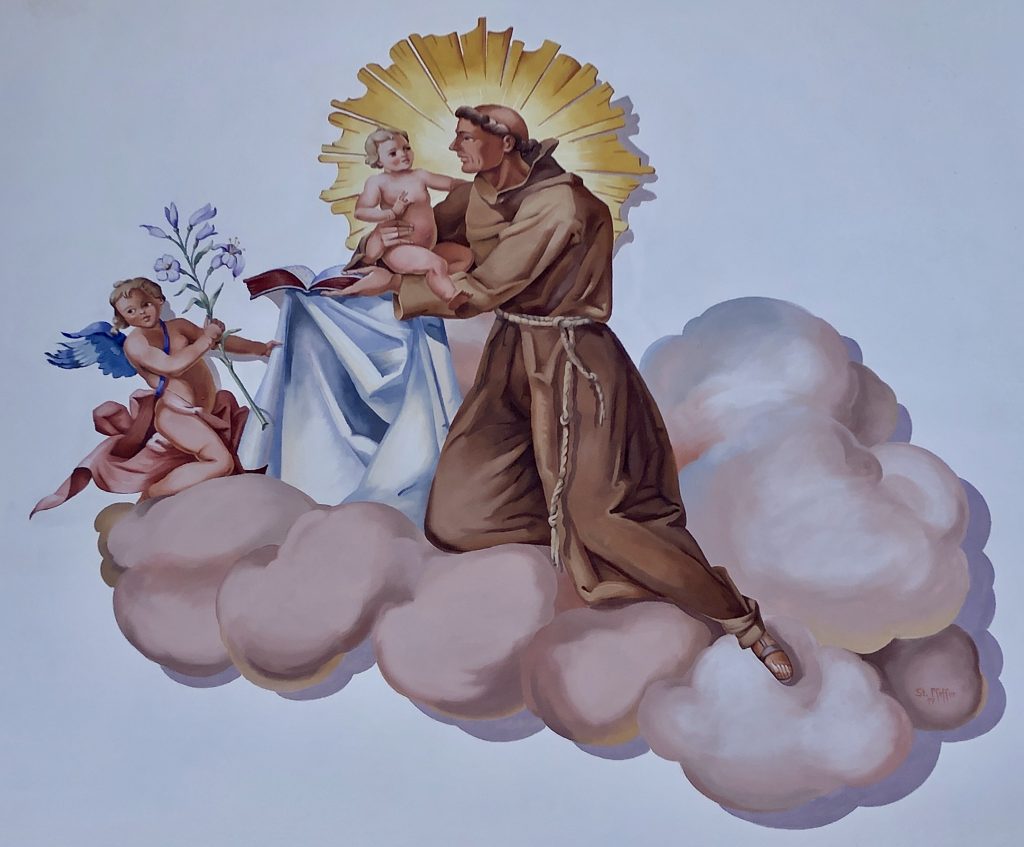
She also completed façade paintings in Grainau and Untergrainau, and even the image of Saint Anthony (1961) on her own grave.

She died on March 19, 1990, in the Partenkirchen clinic.

Christina Dichtl

Between 1991 and 1994, Christina Dichtl attended the State Vocational School for Wood Sculptors and Carvers in Oberammergau.

From 1994 until 2002, she attended 10 semesters at the Academy of Fine Arts in Munich with a specialization in the study of sculpture.

Since 2002, she has been self-employed from her studio in Bad Bayersoien, doing mainly commissioned work in such diverse mediums as sculpture, painting, drawing, calligraphy, mosaics, as well as Lüftlmalerei.

In that time, Dichtl has also represented in various group and individual exhibitions, and participated in many competitions and symposia. 

She has done freelance work as a course instructor in the castle museum Murnau and in the open-air museum Glentleiten, and has taught courses on reverse glass painting, drawing, and working in mosaic. 

She has also been a member of the Living Workshop at the Pilatushaus in Oberammergau, a member of Tusculum artists’ association Murnau, a member of the Inser Hoamat in Garmisch-Partenkirchen, and a member of the Ammergauer KunstHandwerker society.

Active in the field of museum education in local museums, she has also been 2nd Chair of the Art and Culture Association of Bad Bayersoien.

She can be contacted directly through her website.

Otto Ertl

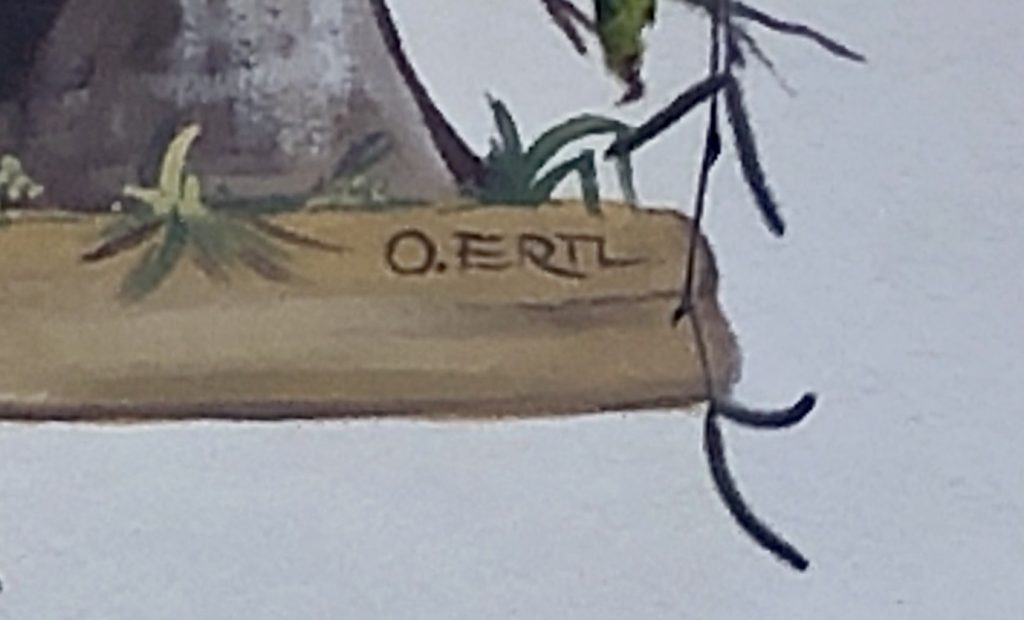
Otto Ertl was born in Garmisch-Partenkirchen on August 19, 1939.

His father, Michael Ertl senior, had spent eight years as a master employee in the studio of the celebrated Lüftlmaler Heinrich Bickel (1948–1956) before opening his own workshop at Weidlegraben in September 1956.21

Otto Ertl, too, had trained with Heinrich Bickel from 1953 until he joined his father in 1956.

In 1963, Otto passed his master’s examination as a painter and varnisher in Passau.

He taught as a specialist at the vocational school for painters and varnishers in Garmisch-Partenkirchen from 1964 until 1972, when his father retired and he took over the family business.

Otto expanded the company to a dozen employees and added new specialities, such as figure painting (“Fassmalerei“), water-gilding, and the restoration of religious sculptures. Among the highlights of his work were restorations of the Zugspitz summit cross and the finish for life-size crib figures in Saint Peter’s Basilica in Rome and the Mainz Cathedral in Germany.22

Now in its third generation, Otto’s son Michael Ertl, junior, took over the family business in 2003.23

Otto Ertl died in Garmisch on January 16, 2023 at the age of 83.24

Gerhard Ester

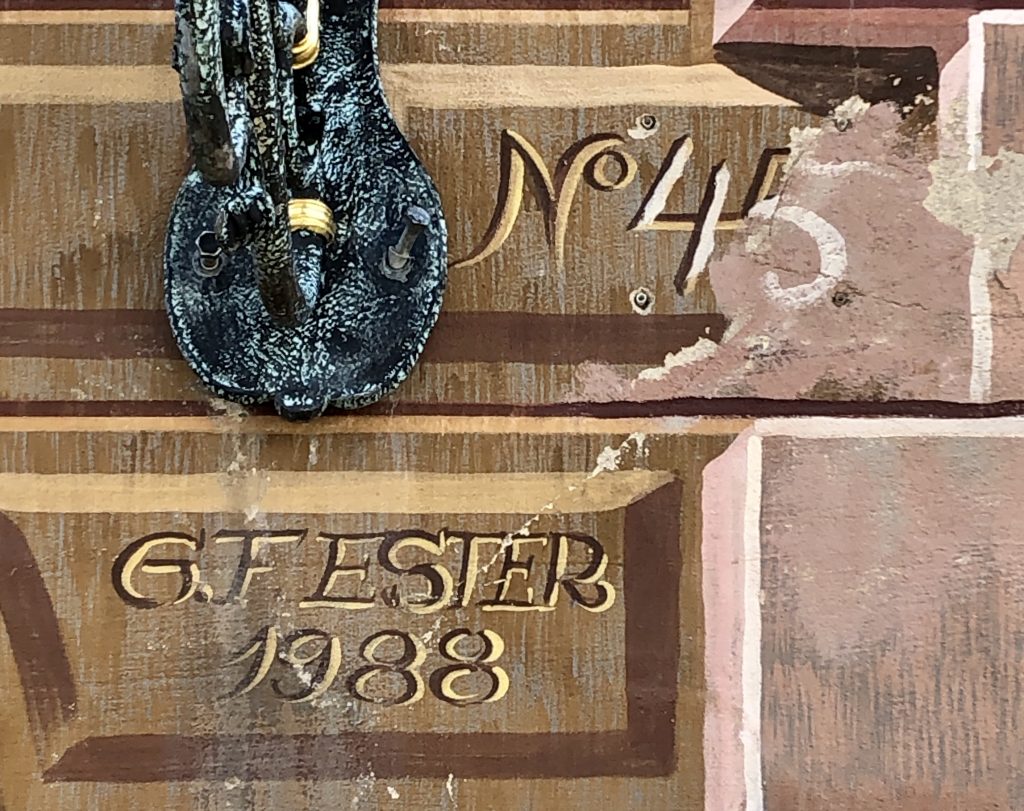
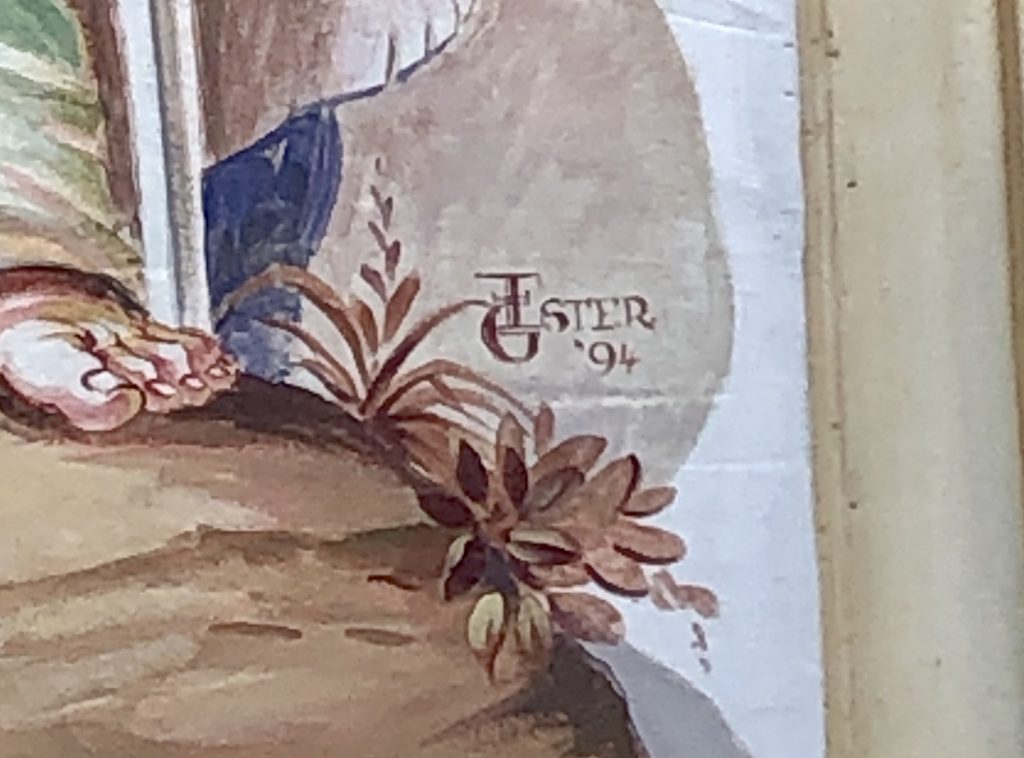
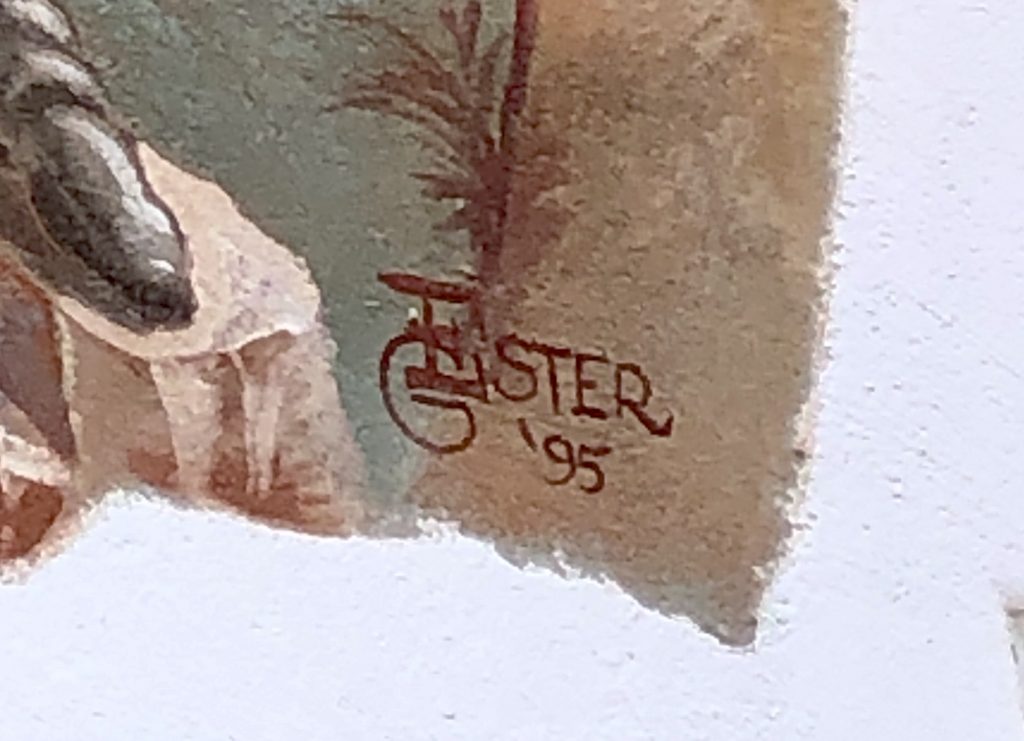
By most accounts, Gerhard (“Gerd”) Friedrich Ester was born in Padua, Italy, on May 23, 1939.

(Only one article from the local Garmisch-Partenkirchner Tagblatt newspaper from July 17, 1985, says that he was born in Prien am Chiemsee in Germany. That article also noted that, “After middle school, evening school, academy and promotional award from his hometown, he made his way to Bad Aibling, Freiburg and Füssen, where he was trained in fresco painting, especially in the classic ‘prima technique'”.)

At the age of seventeen he began an apprenticeship as a church painter and gilder, spending evenings in the drawing class of Max Kuhn. After his first solo exhibition in Rosenheim in 1959, he deepened his craft with the Freiburg restorer Manfred Schmid and, in 1965, went freelance as painter and conservator of murals and polychrome sculpture.25

He lived and worked out of his home in Burgrain.

On January 9, 2013, he was one of the local legends interviewed on Bavarian Television’s “Bayerntour” broadcast.26

Beyond Lüftlmalerei restoration and painting, he also illustrated author Andreas M. Bräus’s book, Culinary Stories from the Werdenfelser Land.27

He died on March 30, 2018, at the age of 78.28

Karl "Hermann" Gemeinhardt

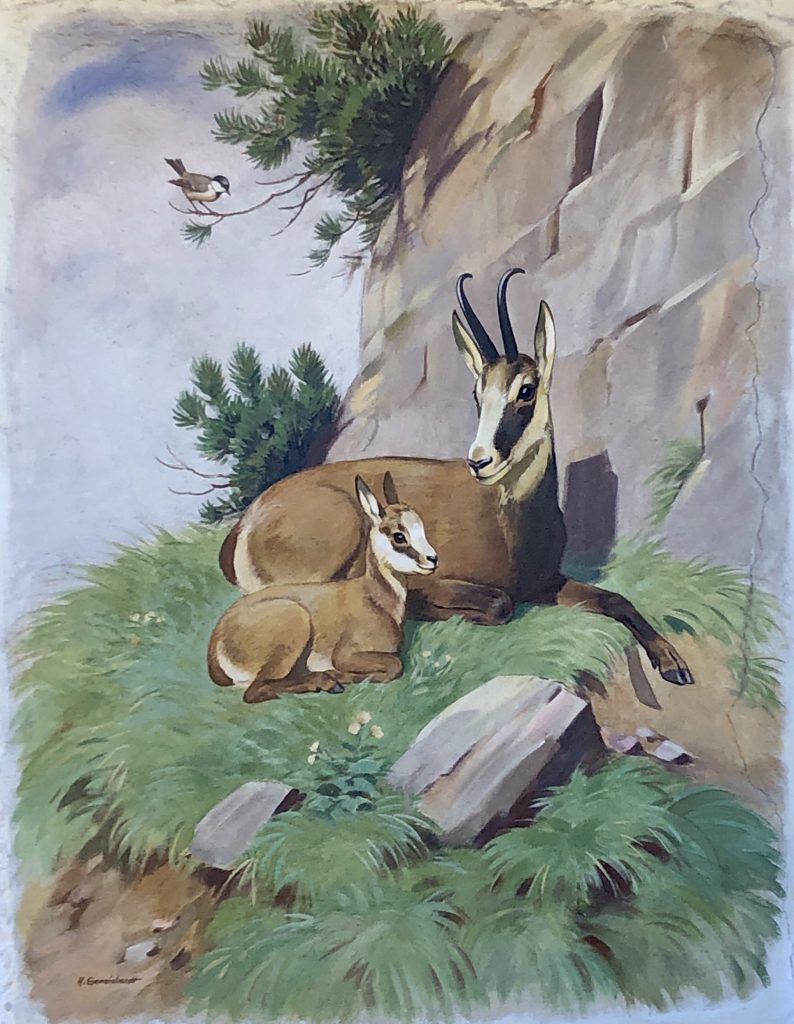
Karl (“Hermann”) Gemeinhardt was a painter of landscapes, portraits, and animals, born February 1, 1905.

Between 1925 and 1930, he studied art at the Akademie der Bildenden Künste in Munich under Angelo Jankwhose specialty was painting animals.

Gemeinhardt spent 3 years working as a painter in the Rosenthal porcelain factory in Selb.

From 1967 until the year he died, he was a member of the Werdenfelser Künstlerbund.

“Hermann Gemeinhardt combines naturalistic design with impressionistic light painting in richly colored landscapes, especially well for example in ‘Im Moor’ with the richness of well-graded tonal values.”

“With loving observation and a fine feeling for their individuality, he depicts cats, dogs, chickens, horses and cows with the eye of a born painter, from whom no nuance of their colorful appearance escapes. Over the years, he has created numerous harmonious animal compositions that appeal to both the mind and eye of the beholder. In his views of the Wetterstein, the artist is fascinated less by the rugged monumentality and wildness of the formations than by the play of light and color”.29

His art illustrates several books, including Tiere der Heimat by Franz Xaver Zedtwitz (1937), Gefallen wir Dir? ein Tierbuch (1972), Tiere auf dem Lande by Lieselotte M. Blasen (1976), and Meine liebsten Tiere by Gisela Fischer (1982).

He painted a Lüftlmalerei of a mother and baby chamois at Bischofweg 6, “Haus Ludwig.”

Gemeinhardt died on September 23, 1985.

Josef "Sepp" Guggemoos

Josef (“Sepp”) Guggemoos was born in Partenkirchen on October 22, 1928.30

He was born into a family of local craftsmen, like his cousin, sculptor Hans Guggemoos, and his son, artist Anton (“Toni”) Guggemoos.

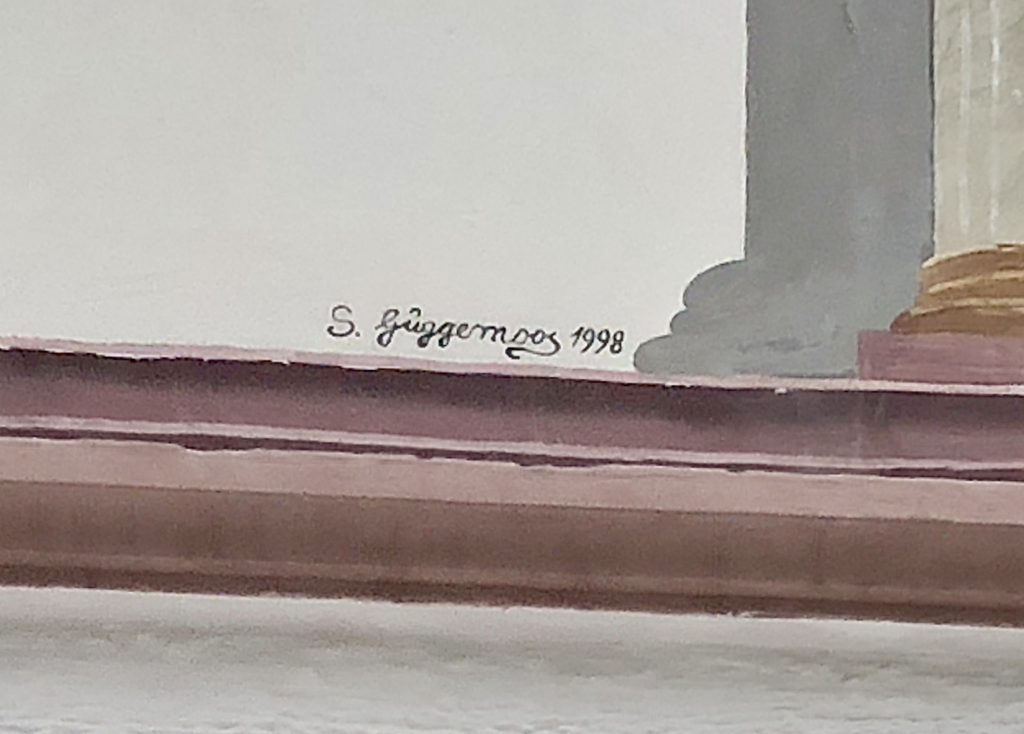
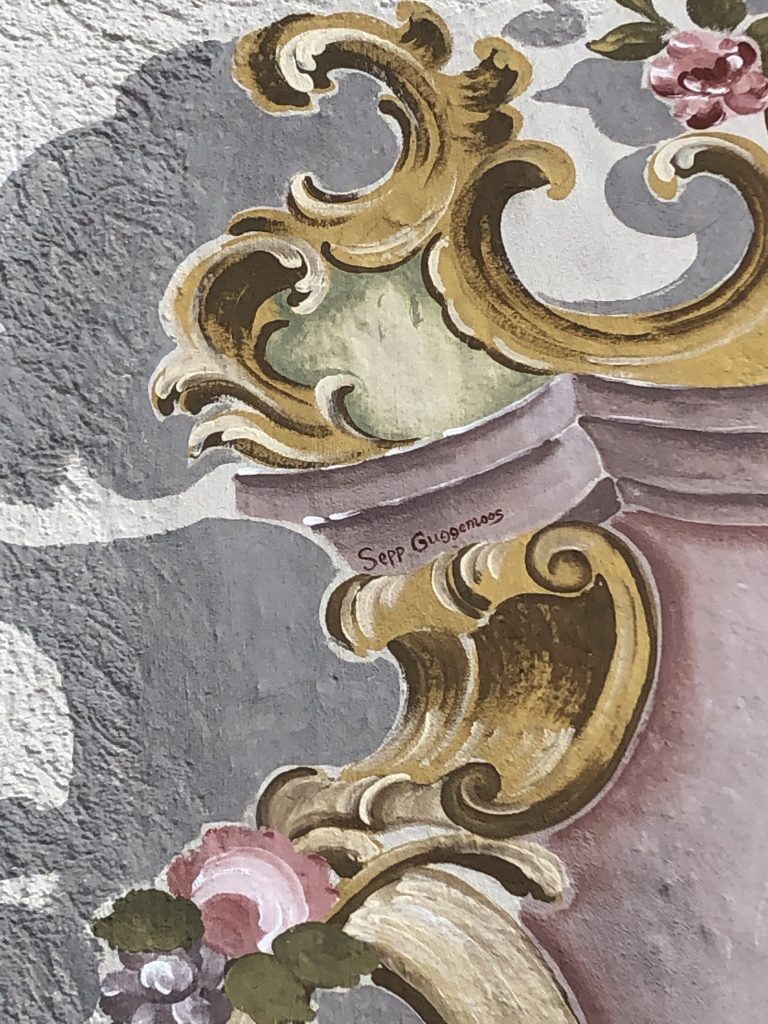
In 1946, at the age of 18,  Guggemoos began an apprenticeship with the celebrated Lüftlmaler Heinrich Bickel (1897-1965).31 The teenager first learned to copy the other artists’ vines and flower scroll-work around windows — an exercise that later became the signature of Guggemoos’s window frames.32

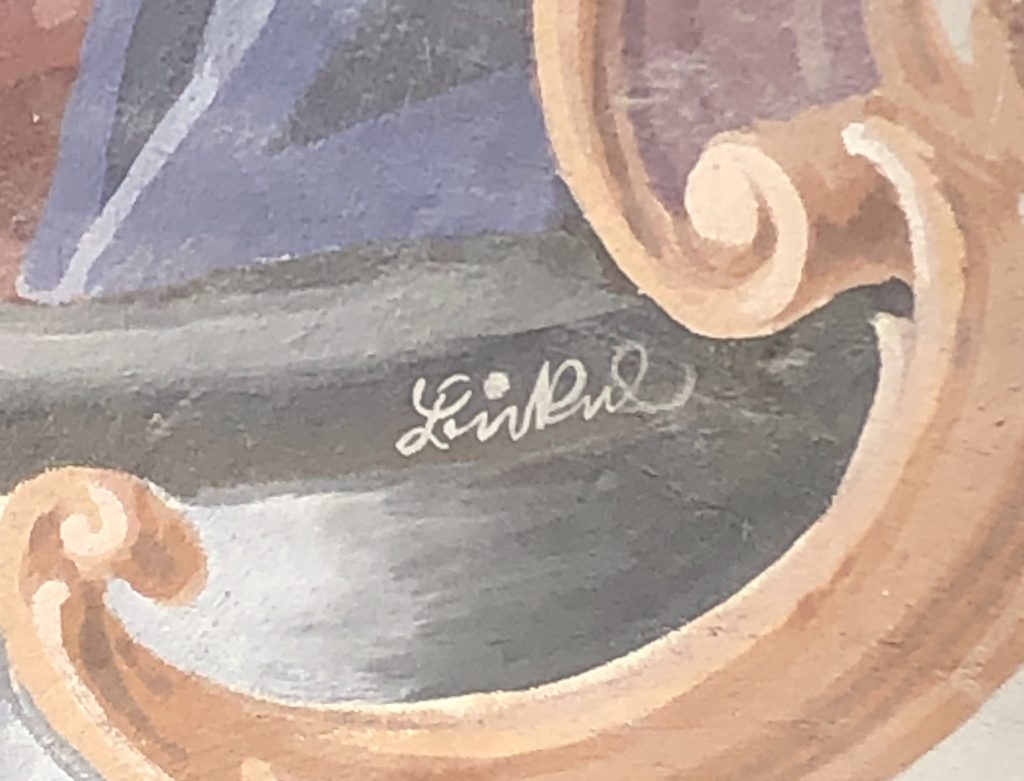
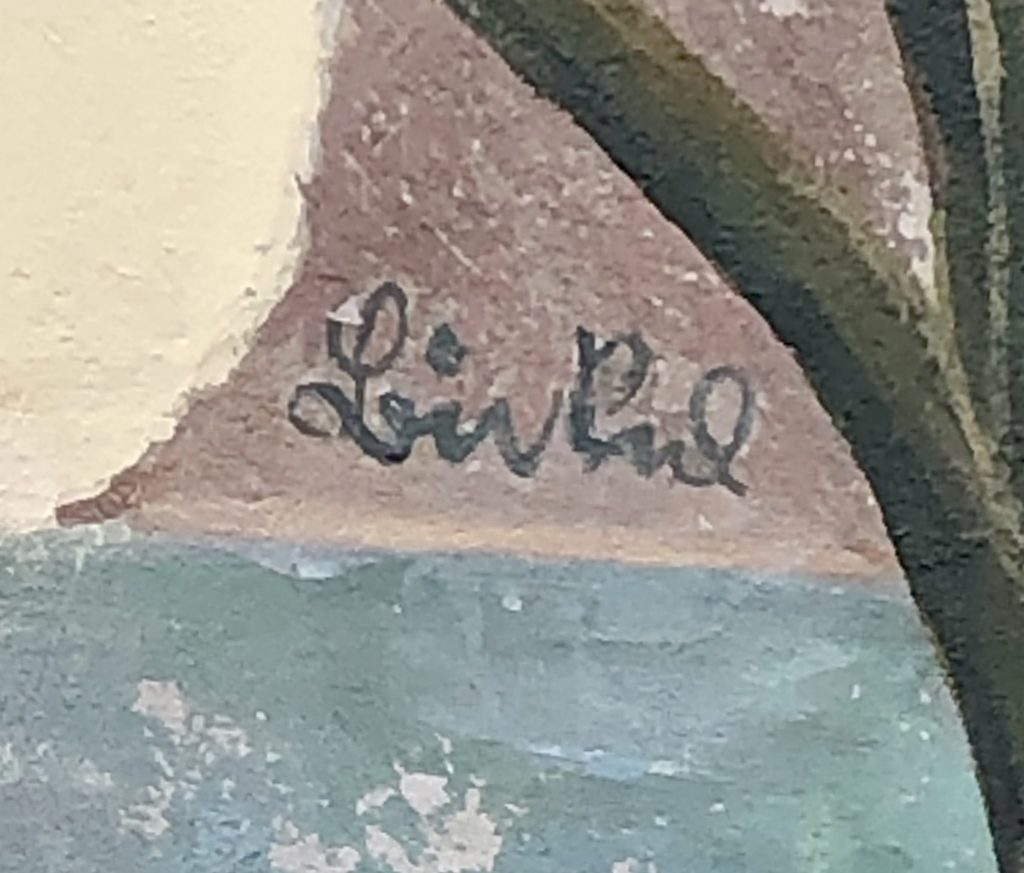
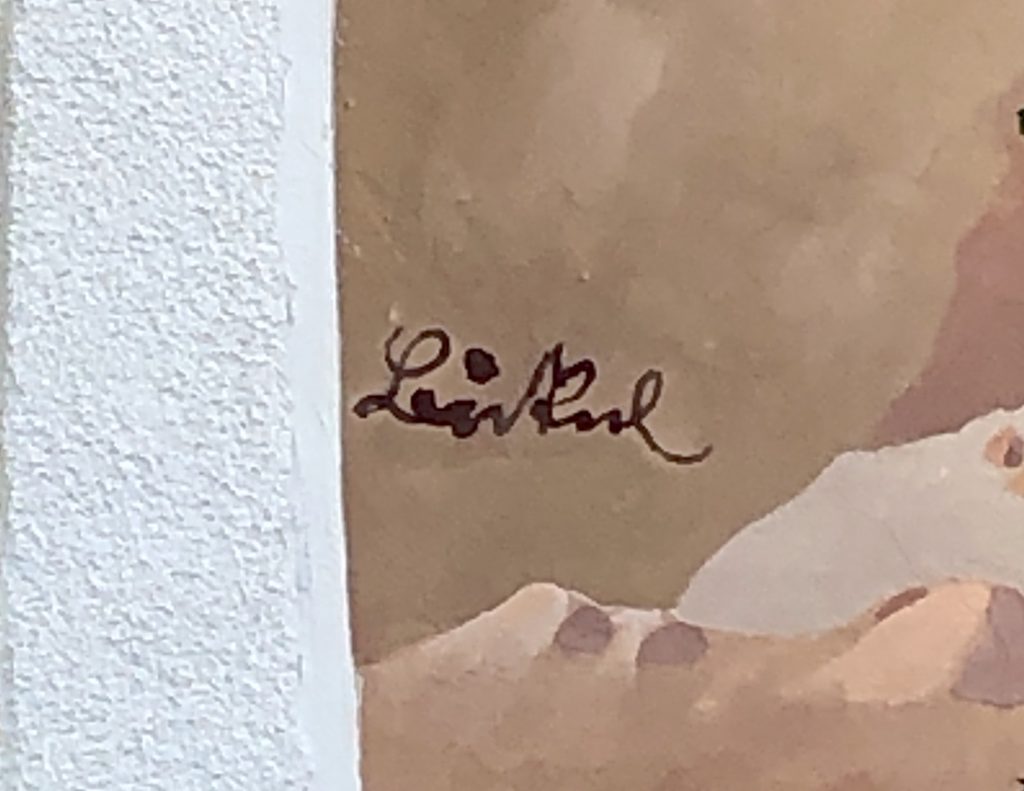
As to the artist’s signature, in German handwriting you will often see a small stroke or swish above the “U” — an “Überstrich.” This is not an umlaut, or a “Ü”.  Rather, because the lowercase “n” and “u” appear the same when written, in order to avoid confusion,  a small stroke or swish is made above the “u”.33

Christoph Hodgson

American-German artist Christoph Hodgson was born in Bamberg in 1952, the son of an American military officer and an actress.  He spent his childhood and youth in Washington, DC.

It was in Washington, DC where he painted his first wall when he was just 12 years old, part of a mural project in Capitol Hill for the inauguration of the president.

In 1968, he returned to Germany and passed his Abitur in Franconia.  Between 1973 and 1978, he studied at the renowned Academy of Fine Arts in Munich.

After his state examination at the Munich Academy of Fine Arts, he initially worked almost exclusively for galleries, exhibited at art fairs in Basel and Cologne, and was secretary of the art salon in the Haus der Kunst in Munich. 

Hodgson has exhibited his art in Munich (at the Haus der Kunst and Forum Galerie Rutzmoser), Cologne (Inter Art Galerie Reich), Basel, Paris (Galerie Alain Blondel), Milan, and Washington, DC (Gallery deGaines).

His extensive sculptural works were used as illustrations for Playboy magazine between 1982 and 1989.

Since the mid-1980s, he has specialized in interior design, creating “Walk-In Pictures,” which the artist describes as not merely trompe l’oeil or 3D paintings in large format, but rather as well-coordinated environments that incorporate light, sound, sculpture, and even the viewer, themselves, in order to achieve the desired ambience — from themed rooms in hotels and event halls, to complete restaurant concepts.

His forms of expression range from photo-realism to expressive, abstract Tachisme. The diversity of his styles results from his willingness to experiment. In the course of his commissioned work, he is repeatedly challenged to use and implement new stylistic devices. This in turn leads to new attempts at free design.

Since 2001, the versatile artist has lived and worked in Arnstadt, Thuringia, with his wife, Heike.  His house on Kohlgasse, the Altes Rektorat, has since become an open space for artists and free spirits. 

In Arnstadt, Hodgson is famous for his work at the Schlossmuseum during its renovation and the redesign of the theater café in the Castle Park. 

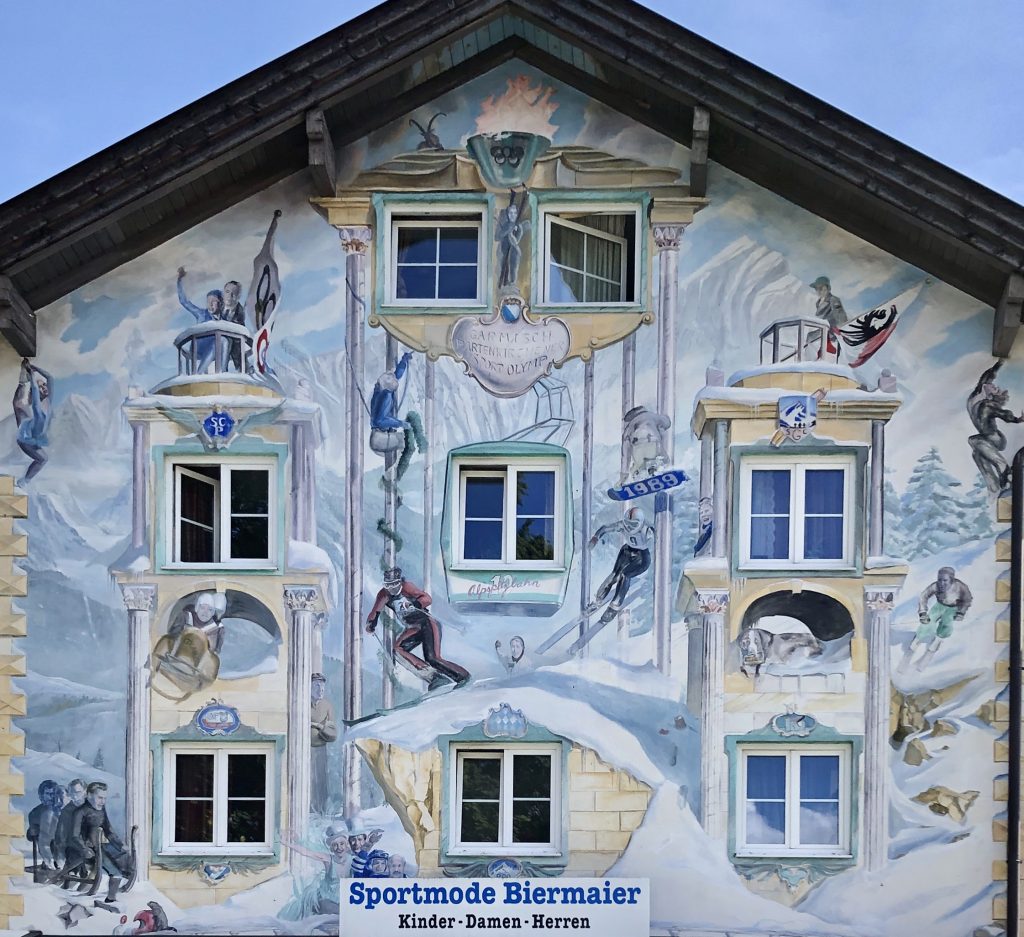
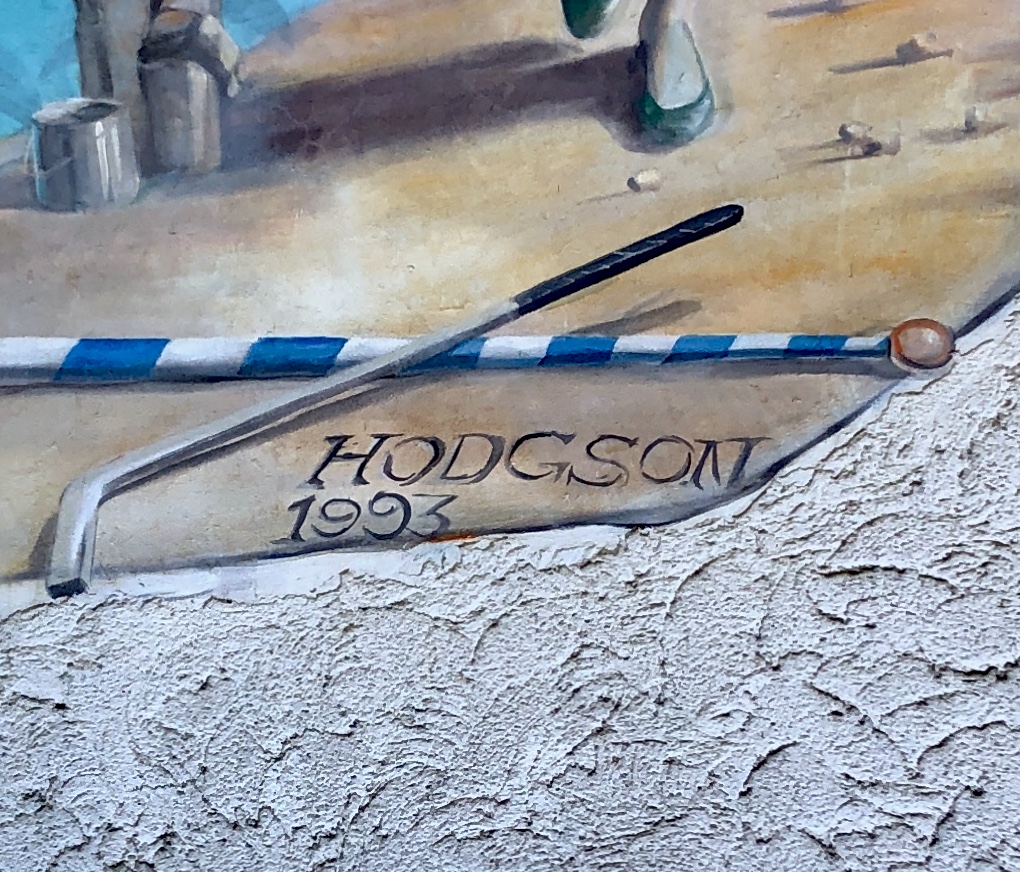
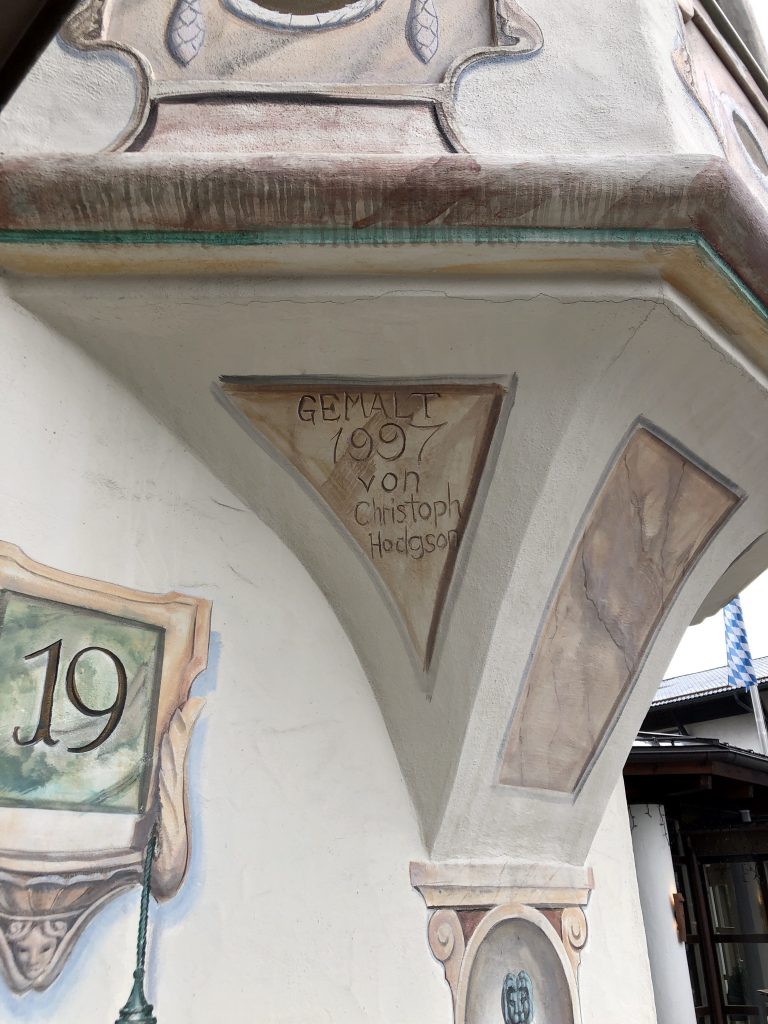
Hodgson has left his signature on many of the buildings in Garmisch, including the Riessersee, Zugspitze, and Dorint hotels.  His work on the walls of Sporthaus Neureuther-Mittermeier (now the Sportmode Biermaier) made national news in 1989.  

He also made headlines for his work on the walls of the “Faustina” cafe in Weimer. Touching on the city’s place in German history, Hodgson’s portrayal of Hitler’s image next to Nietzsche’s sister, Elisabeth Förster, Franz Liszt, and Liszt’s son-in-law, Richard Wagner, caused quite a controversy at the time.  This mural, described by the Buchenwald Memorial as the most courageous contribution to the 1999 cultural year, unfortunately, has since been removed.

You can also find his work in print, as he illustrated Michael Kirchschlager’s childrens’ book, Die Ritter vom schwallenden Wasser, the story of a medieval Thuringian-Franconian knight. 

Hodgson’s art can even be seen at the Bratwurst Museum in Holzhausen.

More information can be found at the Arnstadt Art Gallery and on Hodgson’s own website and Facebook page.

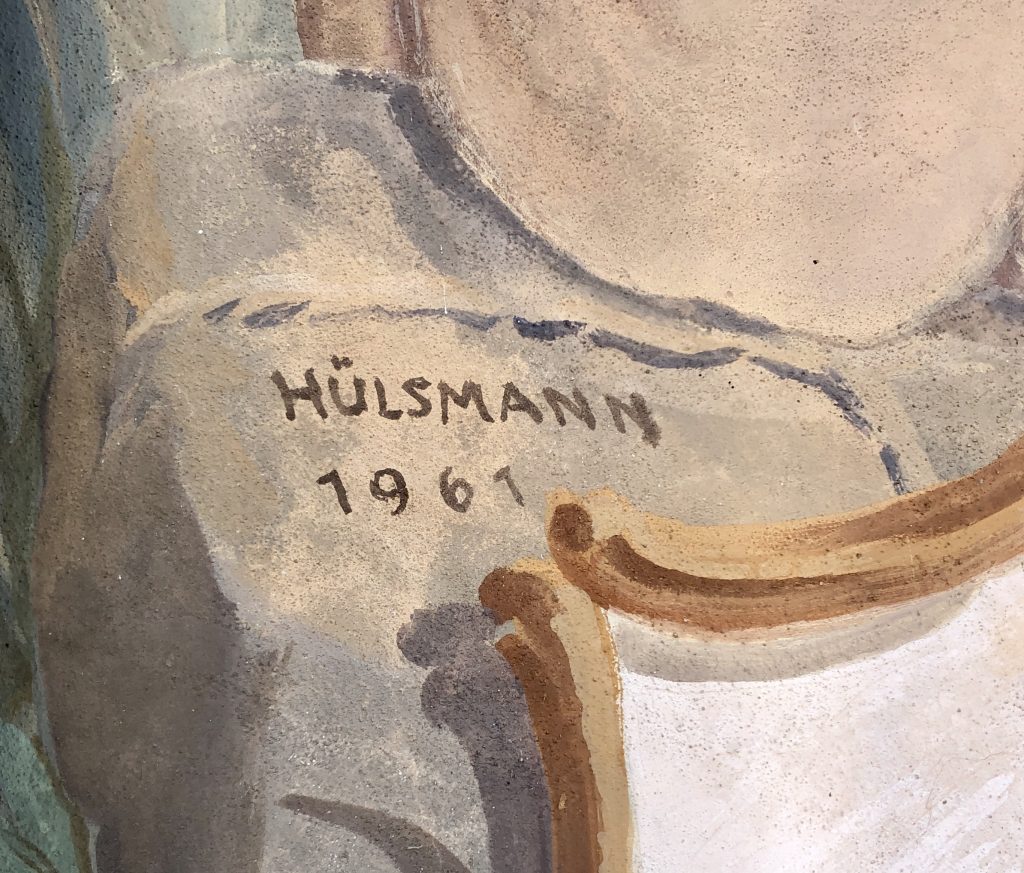
Eberhard Hülsmann, Senior

Eberhard Hülsmann, Sr., born on June 10, 1913 (or June 16, 1915), began his apprenticeship in his parents’ painting business in Partenkirchen, which he took over after his father’s death.

In 1938, he passed the master painter examination in Munich.

In World War II, he was badly wounded and lost his left arm.

After his dismissal, he began studying again, from 1941 to 1943.

His fresco works in Garmisch-Partenkirchen include the Hotel “Zur Schönen Aussicht,” John the Baptist at Brunnhäuslweg 8 “Zum Mesma,” Faukenstraße 13 “Zum Schütz’nweber,” Ludwigstraße 55, and Römerstraße 2.

Despite his disability, he was still standing on the scaffolding working on lüftlmalerei at the age of 76.

He died on April 29, 1995.34

Eberhard Hülsmann, Junior

Eberhard Hülsmann, Jr., born on February 22, 1937, in Partenkirchen, was a graphic artist, fresco painter, and nativity artist like his father, Eberhard Hülsmann, Sr. 

His works include the lüftlmalerei at Ballengasse 4, the interior of the swimming pool in Grainau, and the panorama at the Grainau town hall.35

Max Kaiser

Born in Aising, Rosenheim, on January 6, 1903, Maximilian (“Max”) Kaiser was a sculptor, nativity scene creator, and fresco painter.

He apprenticed at the woodcarving school in Partenkirchen; studied at the art school in Nuremberg, financing his studies as an ornamental carver in a furniture factory; then worked as a restorer in Dresden. 

In the 1930s, he opened a studio for decorative sculpture in Partenkirchen at Ballengasse 8.

In 1935, he married Anna Aumayr, the daughter of local goldsmith Josef Aumayr.

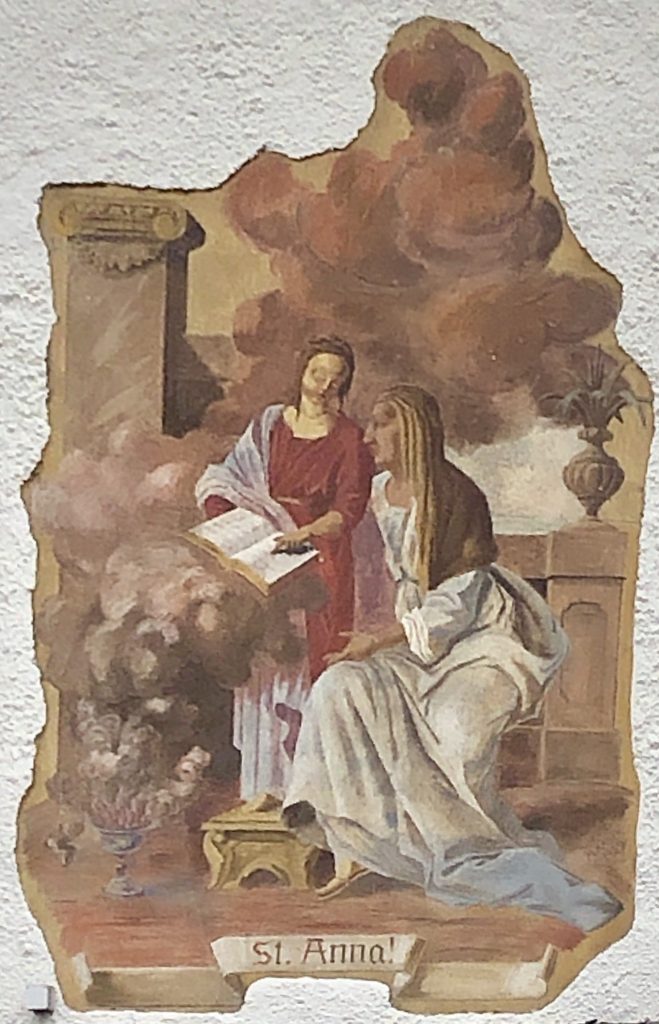
His works include the Madonna at the high altar — a reproduction of Tilman Riemenschneider‘s Marien Altar from the Herrgottskirche in Creglingen — and the altar wings with relief scenes from the life of Jesus at the Marian church in Partenkirchen, as well as the lüftlmalerei of Saint Anna above his father-in-law’s shop at Ludwigstraße 1.  

“In his studio … Max Kaiser, an industrious and extremely stylistically confident artist, together with a total of three assistants (who today are highly respected sculptors who are known far beyond the borders of the Werdenfelser Land) produced almost innumerable works of all kinds and in almost every style: from modest door decorations to the baptismal font in the church, from magnificent stucco work to the nativity scene figure, from the rococo Madonna to the organ prospectus to the complete church furnishings.”36

Kaiser died on July 2, 1976.

Hermann Lang

Munich Architect Hermann Lang worked on numerous buildings in Garmsich-Partenkirchen.

Around 1910, he made plans for an extension to the Partenkirchen town hall.  However, those plans were not executed.  In 1913/14, at the “Neuer Friedhof … [on the] cemetery chapel with monumental onion dome … [he] connected the first floor wings with shingle roofs (keeper’s apartment, crypt arcades).”  In 1918-20, he made plans for a Kurhaus project.  However, it was rejected by the government.  In 1923, he built the home at Dreitorspitzstraße 21, a “country house in alpine home style, with high arbor, balcony, ornamental collar and rich facade painting”.  In 1927, he built the hotel at Prof.-Wackerle-Straße 8, “Haus Zufriedenheit”; “The unusual name, by the way, is immortalized on the bay window in the painting by Heinrich Bickel. To whom the edifying motto goes back to is, of course, unknown: ‘If I am to choose from all goods, I choose contentment. My happiness shall not torment enviers, enough if it pleases only me.'” In 1928, he built the home at Dreitorspitzstraße 53, a “country house in the alpine home style, with high arbour, balcony and corner oriel …”, and on Ludwigstraße, the “Schmöger House”.37

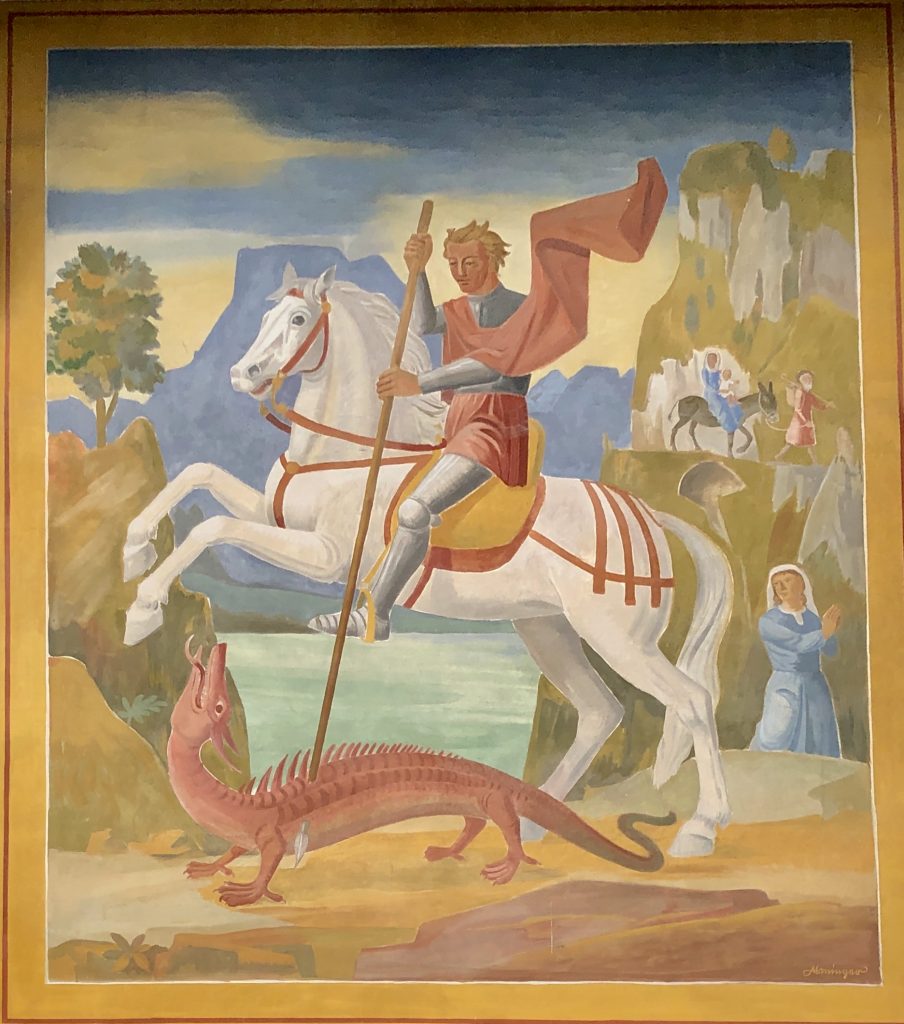
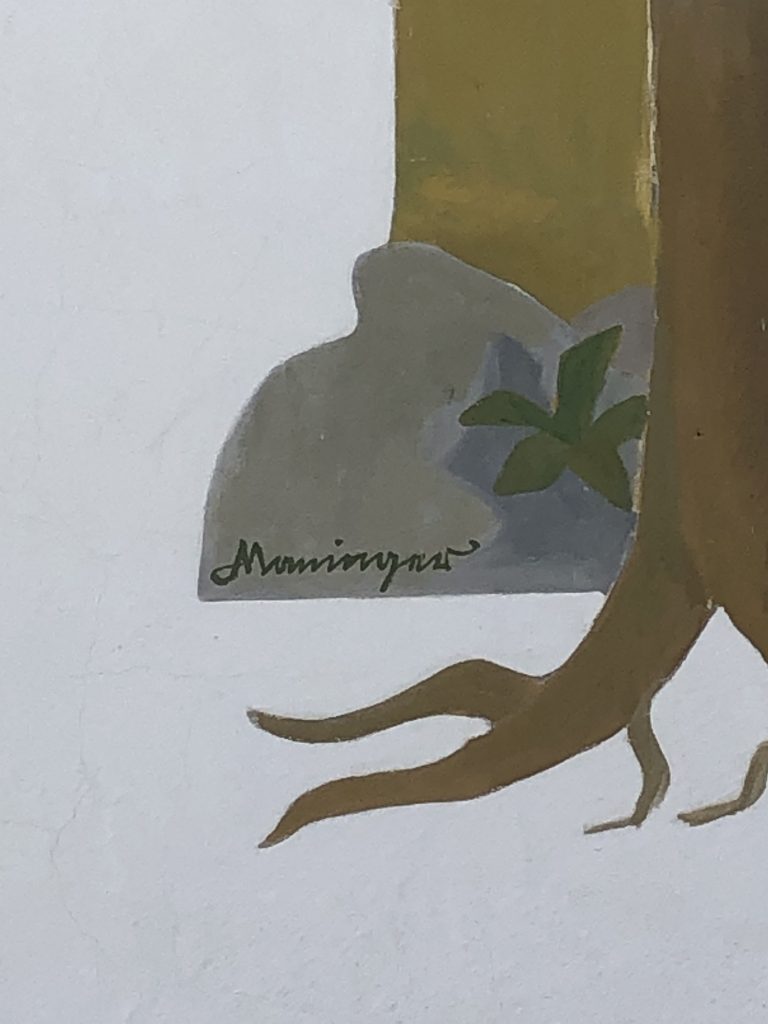
August Maninger

August Maninger was born on January 5, 1903, in Reicholzheim, Germany. 

After studying at the Würzburg Polytechnic, and then at the Academy of Applied Arts in Munich with Professor Josef Hillerbrand, he opened his own art studio on Grubenkopfstraße in the Burgrain district of Garmisch-Partenkirchen in 1934, later expanding his practice to premises in Alpspitzstraße 7 and Am Mühlbach 3.

From 1940 to 1945 he served as a war correspondent, after which he returned to civilian life as an active member of the Künstlerbund Garmisch and a regular exhibitor in the town.

Maninger’s output ranges from small-scale watercolors to large public murals and ecclesiastical frescoes. Among his best-documented commissions were Bauersleute und Hirten (“Farmers and Shepherds”) on the façade of the spa administration building in Bad Kohlgrub, and two companion murals, Patrona Bavariae mit Schulkindern and Baum mit Kindern, for the school at Hauptstraße 16 in Oberau.

The artist died in Partenkirchen on March 26, 1981.38

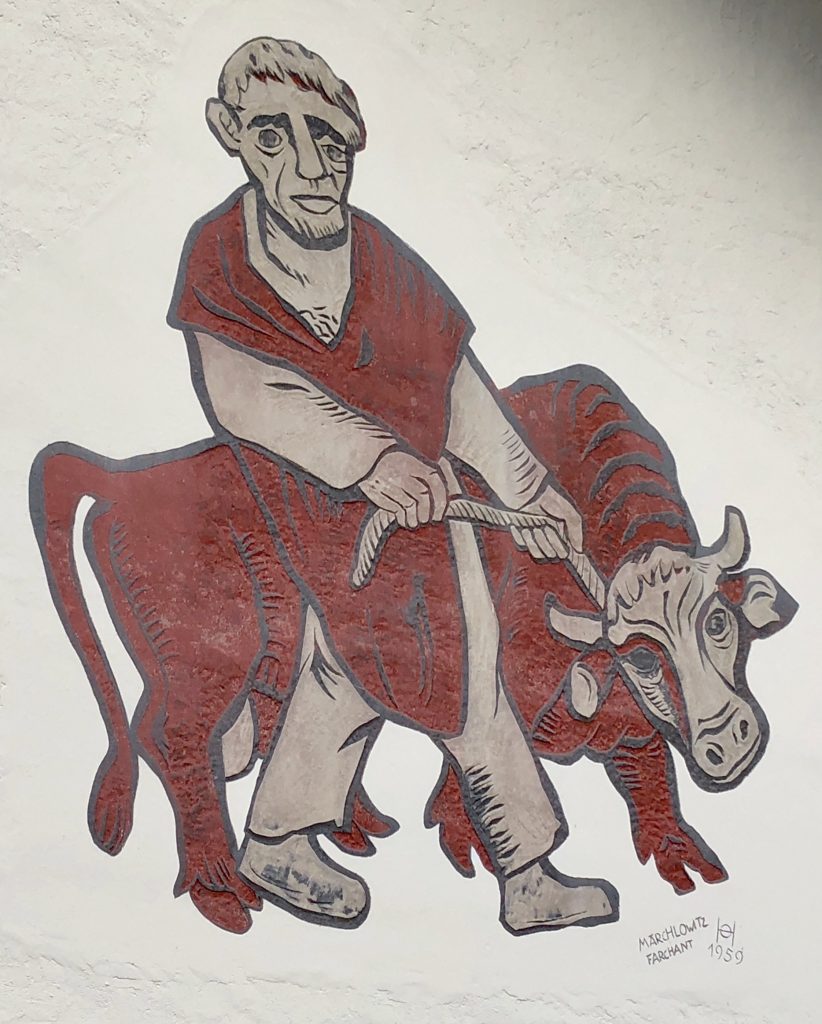
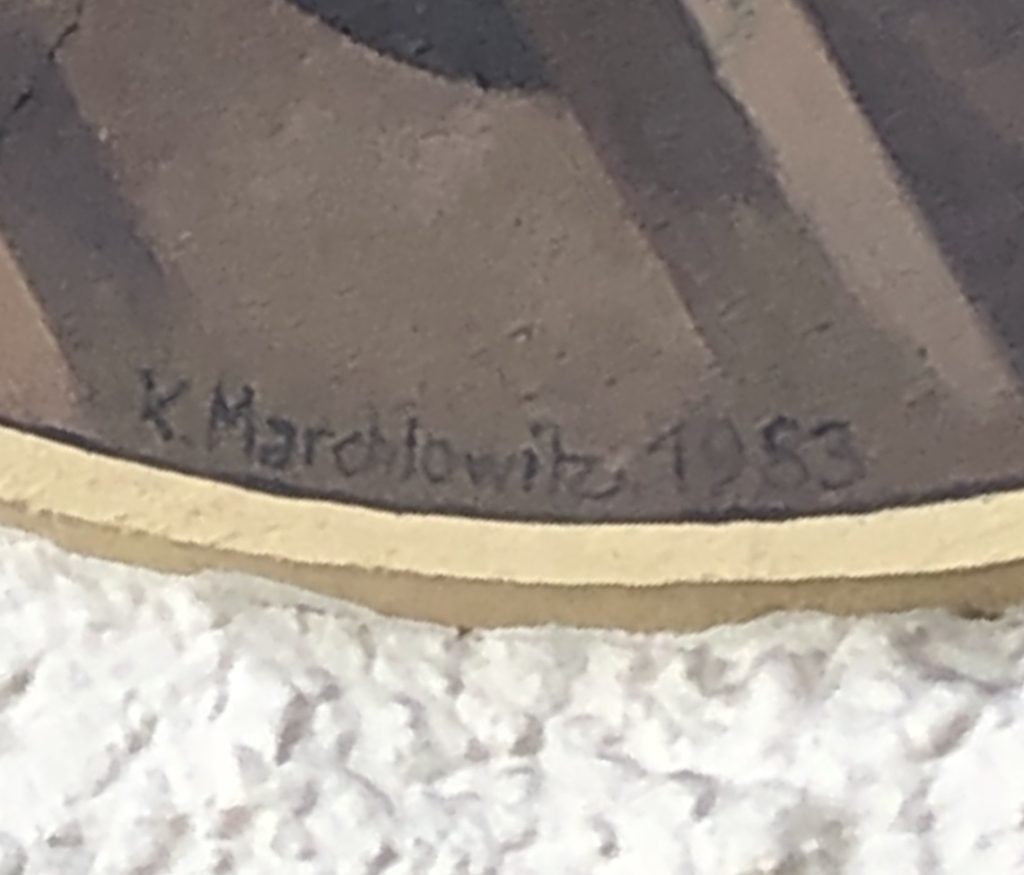
Kurt Marchlowitz

Kurt Marchlowitz was born on December 2, 1913, in Oranienburg, Germany.

Marchlowitz spent his early childhood in Berlin.  He apprenticed as a typeface painter and reverse glass gilder, and founded a business in Partenkirchen painting furniture and frames for wooden sculptures.  

In 1939 he moved to Dorfbachweg 3 in nearby Farchant.  

“His artistic activities included lüftlmalerei, sgraffiti, restoration of old furniture and pictures, paintings in oil on canvas, pastel painting, encaustic (wax painting), watercolors and tempera paintings, mosaics with Murano glass, gilding of wooden sculptures, facade design, etc. Many of his works can still be admired in the entire Ga.-Pa. district – e.g. congress center, casino, Volksbank in Ga., spa guest hall and VR-Bank in Farchant, etc.”39

His art includes works in the Farchant town hall and in the Gasthof Kirchmayer, the Ettal monastery, and several lüftlmalerei in Garmisch-Partenkirchen.

Marchlowitz moved to Israel in April 1993.

He died just five years later, on October 30, 1998.

Hermann Matzen

Hermann Matzen was both a landscape painter and a skilled Lüftlmalerei painter.

With studios at Sankt-Anton-Straße 3 and later at Prof.-Wackerle-Straße 13, by 1938, he belonged to the Künstlerkameradschaft Garmisch-Partenkirchen, a short-lived artists’ association that attempted to coordinate exhibition activity in the district. 

Among his documented work was a joint Lüftlmalerei with Karl Traub at Kohlstattstraße, Partenkirchen, depicting Saint Corbinian.40

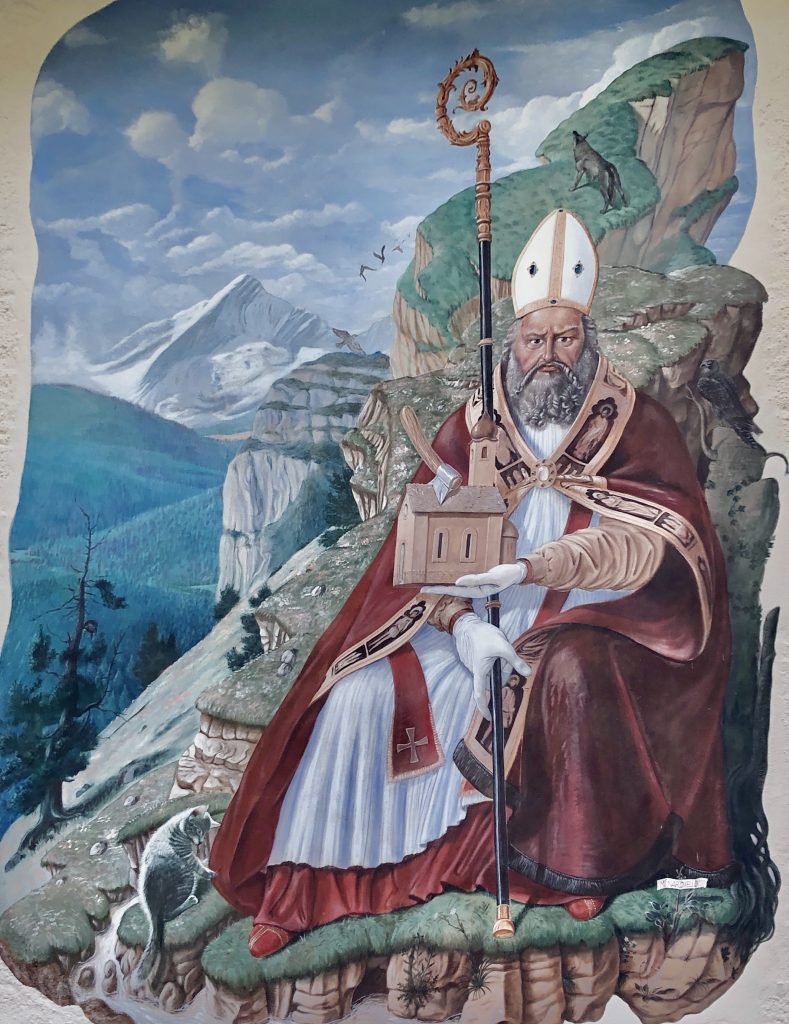
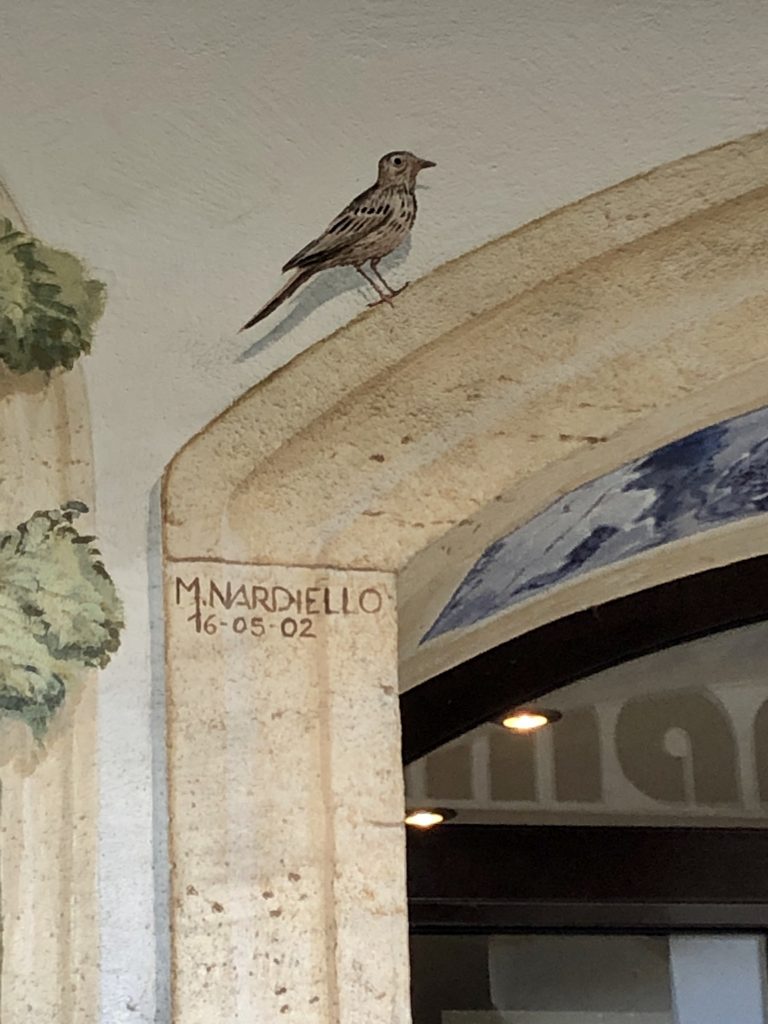
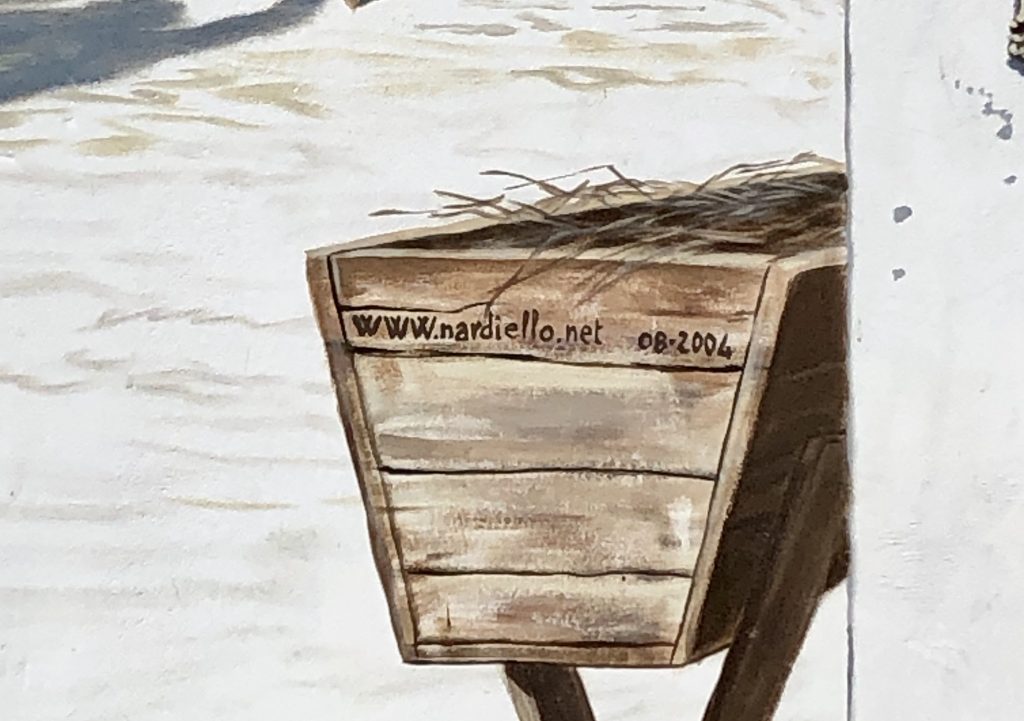
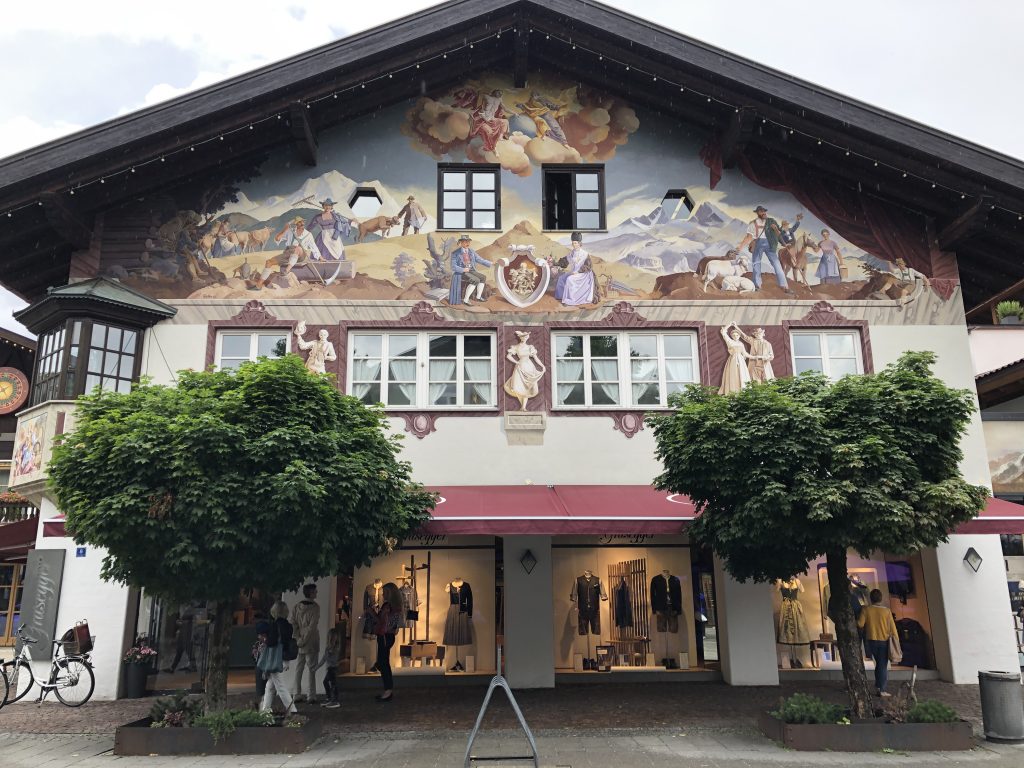
Michele Nardiello

Michele Nardiello was born in 1956 in Gravina di Puglia, Apulia.41

After having completed his first mural in 1973 modeled on the works of the Renaissance masters,  he entered the Accademia di Belle Arti in Carrara, Italy, where he graduated with honors in 1978.42

After graduating, he worked in several Italian cities, broadening his experience in design and large-scale decoration. In 1980 he relocated to Monza and began collaborating with scenographic studios in Milan. During this period, he learned the art of fresco and graffito that would become central to his later practice.43

In the 1990s, Nardiello moved to and worked in Garmisch-Partenkirchen, where he produced beautiful trompe-l’œil Lüftlmalerei.44

His works are still on display all around town — in bars, private homes, the sauna, the walls of the Edelweiss Resort, and others — even though he appears to have closed his atelier on Ludwigstraße in 2022, and has since moved away.

Sebastian Pfeffer

Sebastian Pfeffer was born in Mittenwald on June 15, 1936, the second child of  Johann Pfeffer (1899-1947), a farmer, and his wife Elisabeth, née Fürst (1903-1969).

He began his artistic studies at the vocational school for woodworkers in Garmisch-Partenkirchen.  From 1960 to 1961, Pfeffer attended the Academy of Fine Arts in Munich where he completed his studies as a sculptor under Professor Josef Henselmann.  After graduating from the academy, he began his freelance sculpture work out of a workshop in his own home on Professor-Penck-Straße in Mittenwald.

Academically trained as a sculptor, he only began painting lüftlmalerei in 1970. 

According to Johannes M. Vilanek in a pamphlet he wrote for an exhibition of the artist’s work at the Werdenfels Museum in Garmisch-Partenkirchen in 2001-2002, Pfeffer was inspired to take up lüftlmalerei painting after witnessing what he considered to be an unsuccessful facade restoration in Mittenwald by a “non-local” painter. 

Likely looking at the other artist’s work and thinking, “Well, if he HE can do it…” Pfeffer’s first lüftlmalerei were experiments on the walls of his own home, reminiscent of the Augsburg masters Johann Evangelist Holzer (1709-1740) and Matthäus Günther (1703-1788).

The economic boom between 1970 and 1990, triggered by the huge increases in summer and winter tourism, led many inns, hotels, businesses and banks — not to mention farmers — to pay to have their blank whitewashed walls filled with facades.

Sebastian Pfeffer took advantage of the renewed interest in this “public gallery” and used it to advertise his work to art-savvy holiday-makers, who would see these lüftlmalerei business cards 365 days a year, radiating local culture and bringing joy. The painter not only painted new lüftlmalerei, but also saved many decaying works from being painted over or whitewashed.

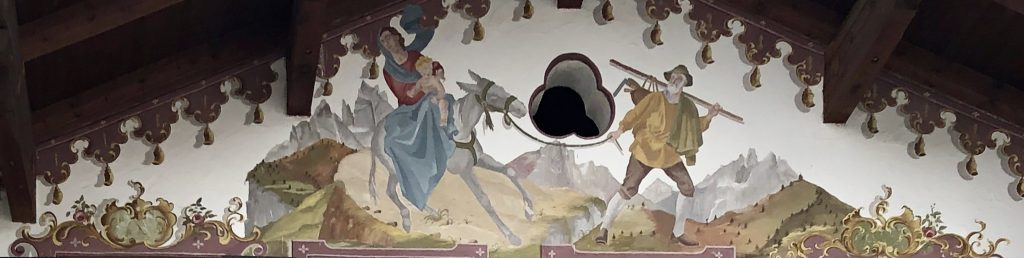
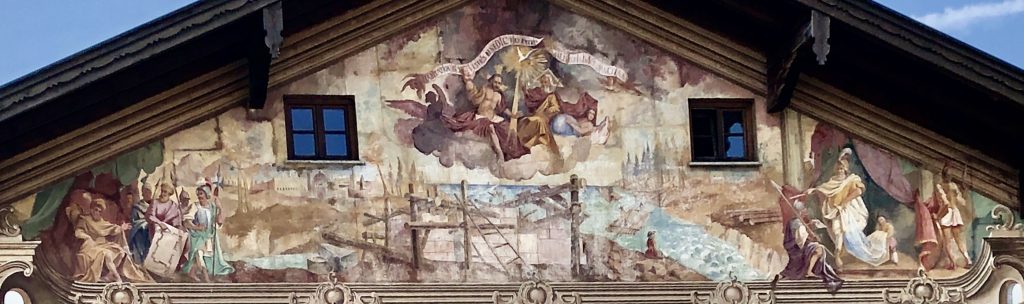
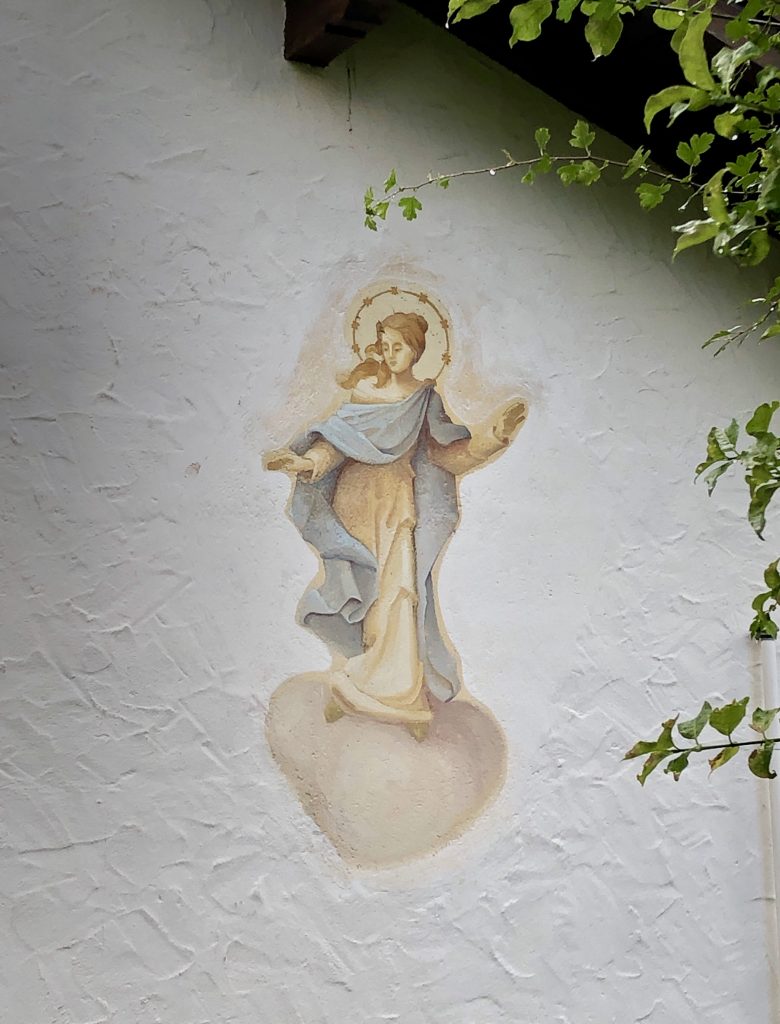
In his heyday, Pfeffer was prolific and his art was diverse.  His lüftlmalerei reflect the rural cultural landscape of the Werdenfels region, including Biblical representations with individual figures and groups of figures on cloud banks; Evangelists, namesake and patron saints on pedestals, consoles and cornices; Christian virtues and allegorical representations alternating with mythological scenes; historical events; pretty, richly decorated courtly pairs of distinguished societies; rural life with various pets, work, music, dance, entertainment, national defense, national emblem, family coat of arms and hunting; Craftsmen and instrument makers at work and with their tools; Merchants and traders in historical clothing with traditional figures and their goods, as well as innkeepers with their hostel signs…  And on and on and on.

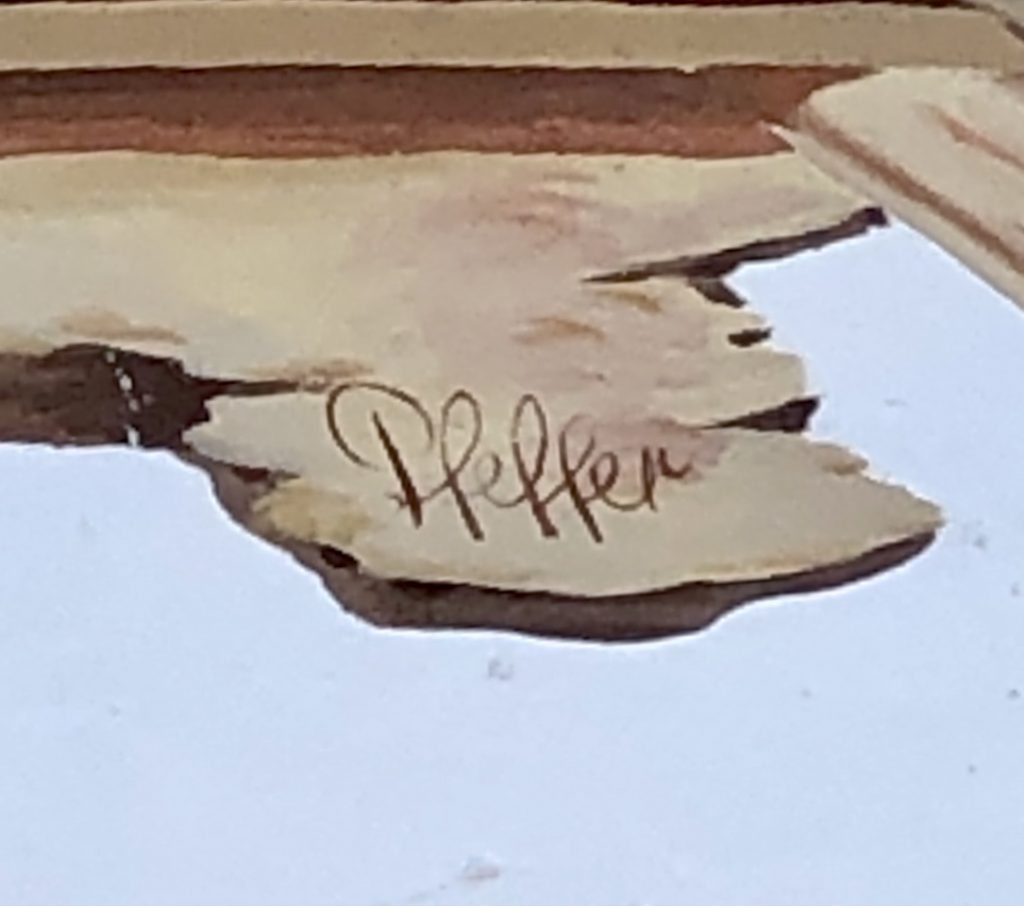
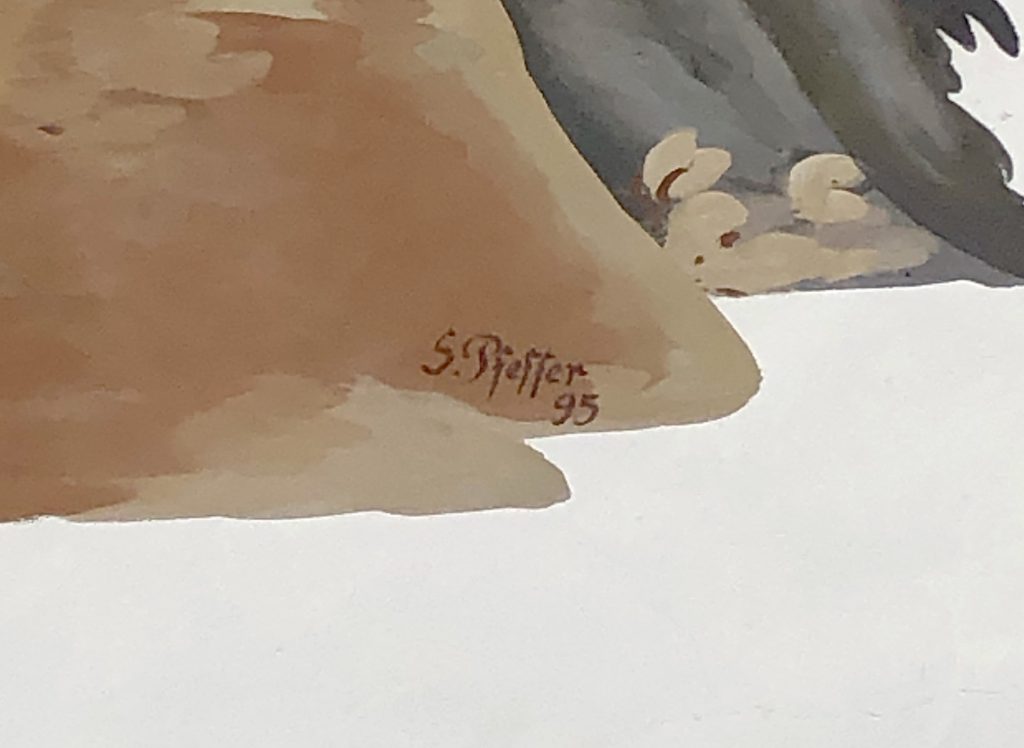
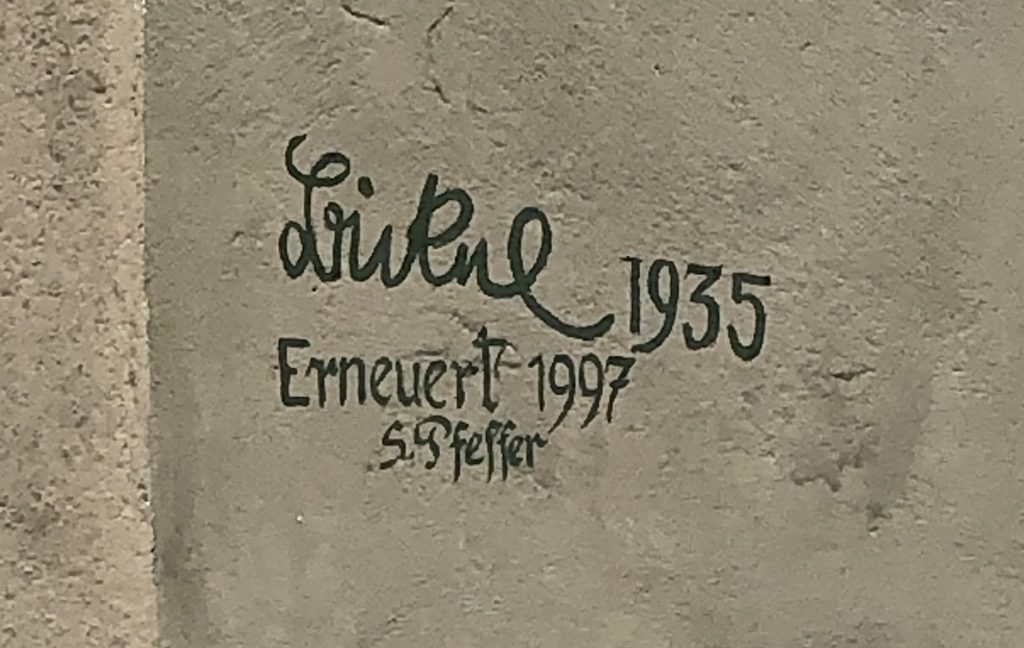
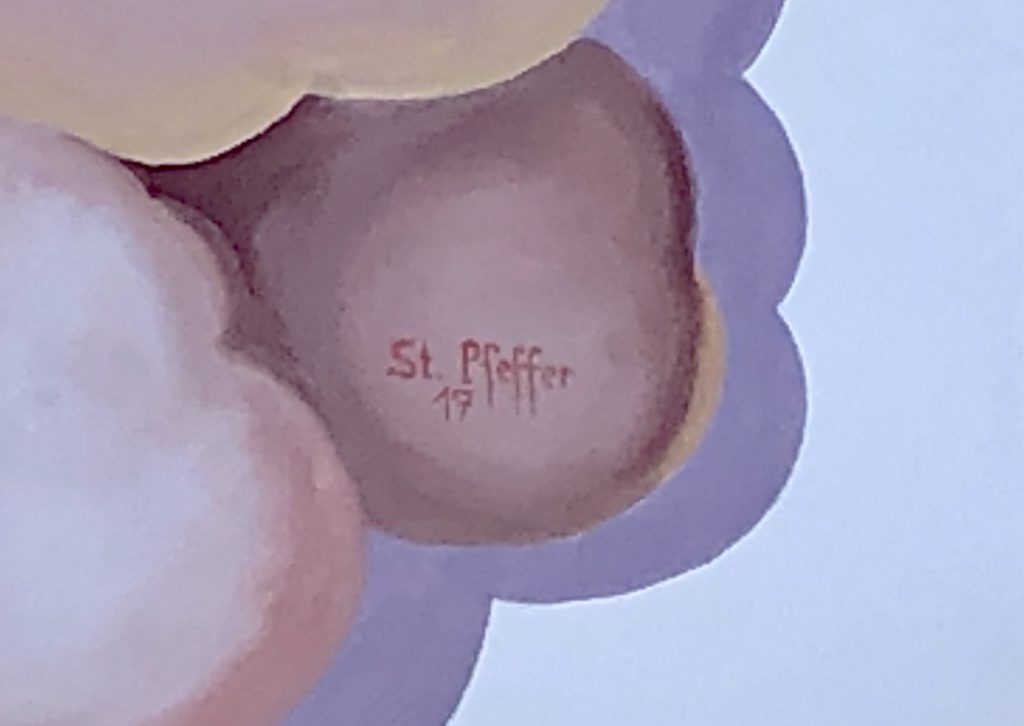
His son, Stephen, joined him in the lüftlmalerei business, and, not only are their styles remarkably similar, but their signatures are nearly identical. 

If there’s only a “Pfeffer,” in the signature, or if there’s an “S” or a “Seb,” that’s Sebastian.  If there’s an “St,” it is a work by his son, Stephan.

Stephan Pfeffer

Stephan Pfeffer, born in 1962, himself a master sculptor and Lüftlmalerei painter, continues his father’s style of painting.

According to his website,45 it is because of the extremely rich creative power of his father Sebastian Pfeffer, and growing up in a family of artists, he has tried to develop his father’s original style into something of his own.

Among his notable sculptural works is the life-size lime-wood relief of Saint Elizabeth of Thuringia, unveiled in the parish church of Saint Joseph, Tutzing, on March 2010.46 Two years later, the Mittenwald municipality appointed him artistic director of the medieval Bozner Markt for 2012, for which he devised an enlarged scenic layout that framed the nine-day spectacle.47

On September 11, 2012, Pfeffer’s work reached an international television audience when Episode 7 of the HD series Die Alpen von oben (“Von Mittenwald ins Allgäu,” Vidicom 2012) portrayed him as “the Lüftlmaler of Mittenwald,” emphasizing his efforts to “give an old custom a future.”48

Carl Reiser

Carl Reiser was born in Partenkirchen on June 5, 1877, the eldest child of Karl Reiser, the royal Bavarian post-master stationed at the Partenkirchen Post-Hotel.49

Carl Reiser attended the royal secondary school in Freising until he graduated from high school, then began an apprenticeship in the hotel business in London.  He dropped out, however, and began studying in Paris in 1898 with the famous “Academie Julian”. In Munich he attended the Academy of Fine Arts before moving to the painting school of the Slovenian late impressionist painter Anton Azbe (1862-1905). There he got to know the new liberal contemporary art movement with naturalism and color theories as well as the virtuoso spatula technique. In the Munich Secession, founded in 1892, the young artist was able to exhibit as a guest and experienced the beginnings of Expressionism.

Others followed with the silver medal at the World Exhibition in Paris (1913) and the gold medal (commissioned by the King of Siam in 1914) at the Munich International Art Exhibition. During the World War he became vice-sergeant in the artillery regiment, and after the end of the war his artistic career continued in Munich and then again in Partenkirchen as a landscape painter from 1933. After the end of the Second World War, Reiser devoted himself to the reorganization of domestic artist life and founded the “Werdenfelser Künstlerbund”, which he headed as president until his unexpected death in 1950.

Wolfgang Schennach

Wolfgang Schennach was born in Ehrwald, Austria, on August 15, 1934. 

After the Second World War, Schennach’s talent was discovered by Rudolf Gopas.  Between 1946 and 1949, when Gopas left with his family for New Zealand, Shennach took lessons from the artist. 

From then until 1952, he attended the Federal Trade School — the Bundesgewerbeschule — in Innsbruck. 

In the following years, he worked internationally as a painter in Austria, Switzerland, Sweden and Holland, and was a guest at the Academy in Amsterdam.

From 1958 until 1965, Schennach taught at the Master School of Painting in Baden, Austria.

In 1965 he settled in his hometown of Ehrwald as a freelance artist.

In 1989 he spontaneously decided to paint “Pictures for Armenia” for the victims of the earthquake.

Wolfgang Schennach was never bound to a particular style. Portrait painting, nudes and landscapes were his strengths. He helped shape the look of the town of Ehrwald with his lüftlmalerei and mural paintings.

He died in 2004.

Karl Traub

Karl Traub was a furniture artist and frescoist in Garmisch-Partenkirchen.50

On January 4, 1935, at the first government meeting of the newly combined Garmisch-Partenkirchen, he was one of the 22 men appointed to the local council.

Josef Wackerle

The importance of Josef Wackerle to Garmisch-Partenkirchen cannot be overstated.  He was closely connected to the monuments of his hometown — having literally lived in some of them — but also in his lasting artistic contributions.  He designed the layout of the Partenkirchen Sebastian monument after the First World War, the reliefs in the auditorium of the Werdenfels high school, the sculpture of Christ in the chapel near Saint Anton, the Partenkirchner church entrance, the “Harmonica Player” in the Garmisch Kurpark gardens, the Lüftlmalerei on the town hall, the votive picture of the memorial chapel on the Kramer plateau, and much, much more. 

Josef Wackerle was born in Partenkirchen on May 15, 1880, at Ludwigstrasse 47 — at what is now the Werdenfels Museum.

At the age of 13, he began studying at the technical school for woodcarving in Partenkirchen.  From 1896 until 1899, he attended the Munich School of Applied Arts.  In 1899, he received a scholarship to travel to Italy, where he focused on ancient art and pottery, and became focused on sculpture.  From 1900 until 1904 he studied at the Academy with Wilhelm von Rümann.  

After another study abroad in Italy in 1905-06 — this time visiting Rome, Naples, and Ischia — he won his first awards, displayed at a large art exhibition in Dresden, and received orders for his work from the Nymphenburg Porcelain Factory in Munich. 

From 1906 until 1909, he worked as the  artistic director of the Nymphenburg Porcelain Factory. His majolica figures of the Bavaria on the Theresienhöhe there established his early fame.  In 1910, he designed magnificent ornamental birds for the world exhibition in Brussels, which to this day adorn the Nymphenburg Botanical Gardens.

Between 1909 and 1917, he was a teacher at the Kunstgewerbemuseum, the Museum of Decorative Arts, in Berlin.  

From 1917 until 1923, he taught at the Munich School of Arts and Craft.

In 1922, he moved into the house next to the Saint Anton Monastery in Partenkirchen.

From 1923 on, he was a professor of art at the Munich Academy.  

After the end of World War II, despite the bombed-out studio and destroyed apartment, Josef Wackerle, who was already in poor health, took over the presidency of the Academy of Fine Arts. He has long been an honorary member of the Bavarian Academy of Fine Arts, holder of the Bavarian Maximilian Order, and many other cultural awards.

In 1950 Prof. Wackerle retired his home beside the Saint Anton monastery. 

He died on March 2, 1959, in Garmisch-Partenkirchen.

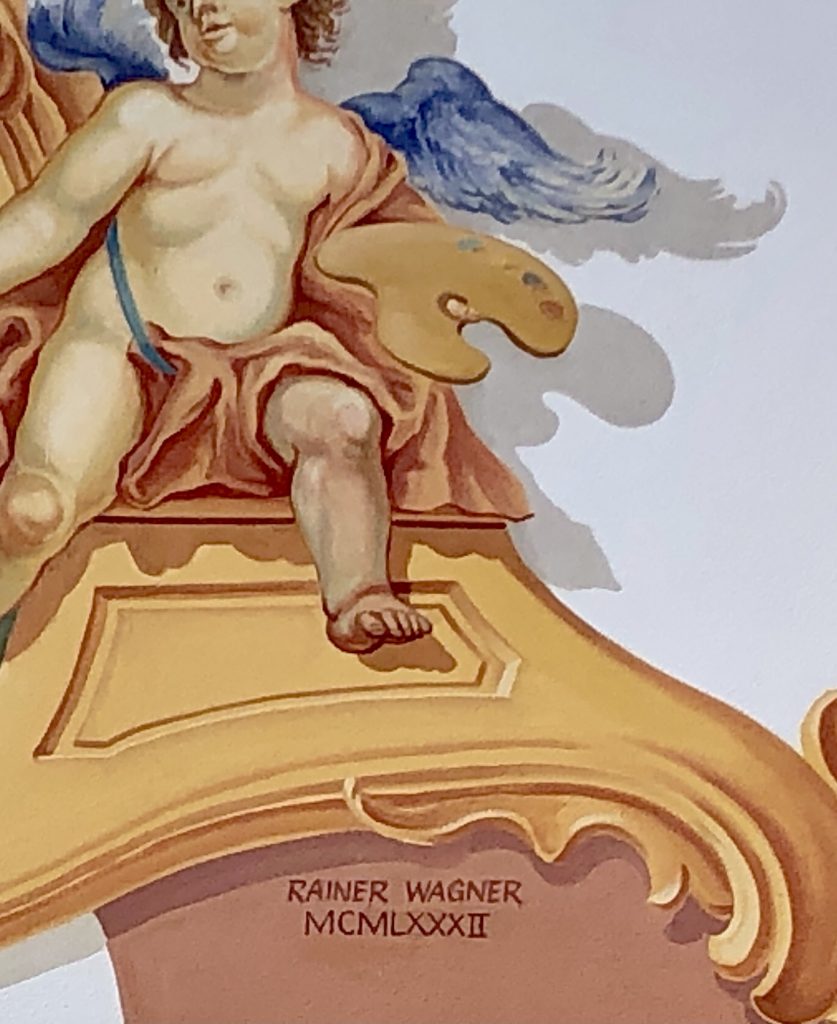
Rainer Wagner

Rainer Wagner was born in Oberammergau in 1945.

After an apprenticeship as a Fassmaler and gilder in Munich, Wagner was the national winner of the Leistungswettbewerb des Handwerks competition. 

He graduated from the Master School of Munich as a church painter, and was self-employed in that profession until 1989.

In 1989, Wagner received recognition for his status as an artist by the Commission for Painting and Sculpture of the Munich Academy of Fine Arts.51

In 2011, he and his wife and fellow church-painter, Elisabeth, undertook the conservation and restoration of the fourteen Stations of the Cross that line the pilgrimage path to the pilgrimage church to Saint Anthony in Partenkirchen.52

Rainer Wagner currently resides in Bad Bayersoien.

Franz Winterholler

Franz Winterholler was born January 29, 1932, in Garmisch, the son of painter Isidor Winterholler.

Between 1947 and 1950, he apprenticed with his father, eventually becoming a master painter in his own right — an artist of wall frescoes and landscape paintings.

“At an early age he set out to follow in his father’s footsteps, learned painting from scratch, successfully completed the master school in Munich, which he left as a master painter. Soon he also created his first Lüftl works, of which today – to name just a few examples – the Steuben Hotel, the Gasthof ‘Schranne’, but also many private houses in the district and beyond bear witness to his creative power in Garmisch-Partenkirchen. His hobbies included hunting, but also skiing (he was a member of the Garmisch ski club for many years) and he also loved to socialize. He often performed as a musician with his Ziach.”53

He died on February 23, 1992.

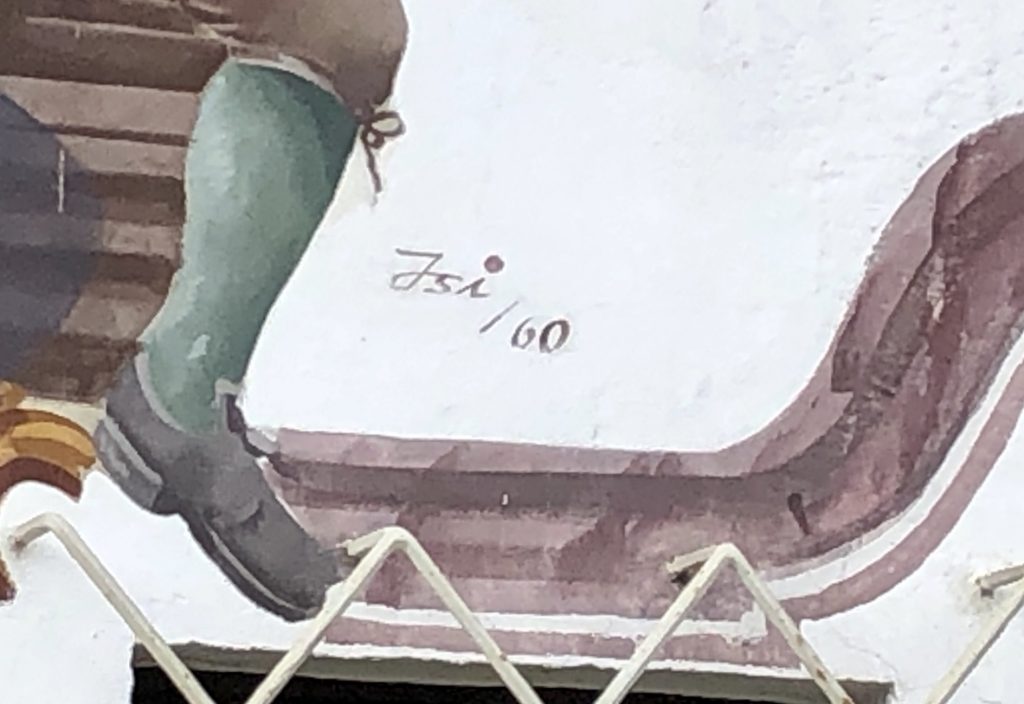
Isidor Winterholler

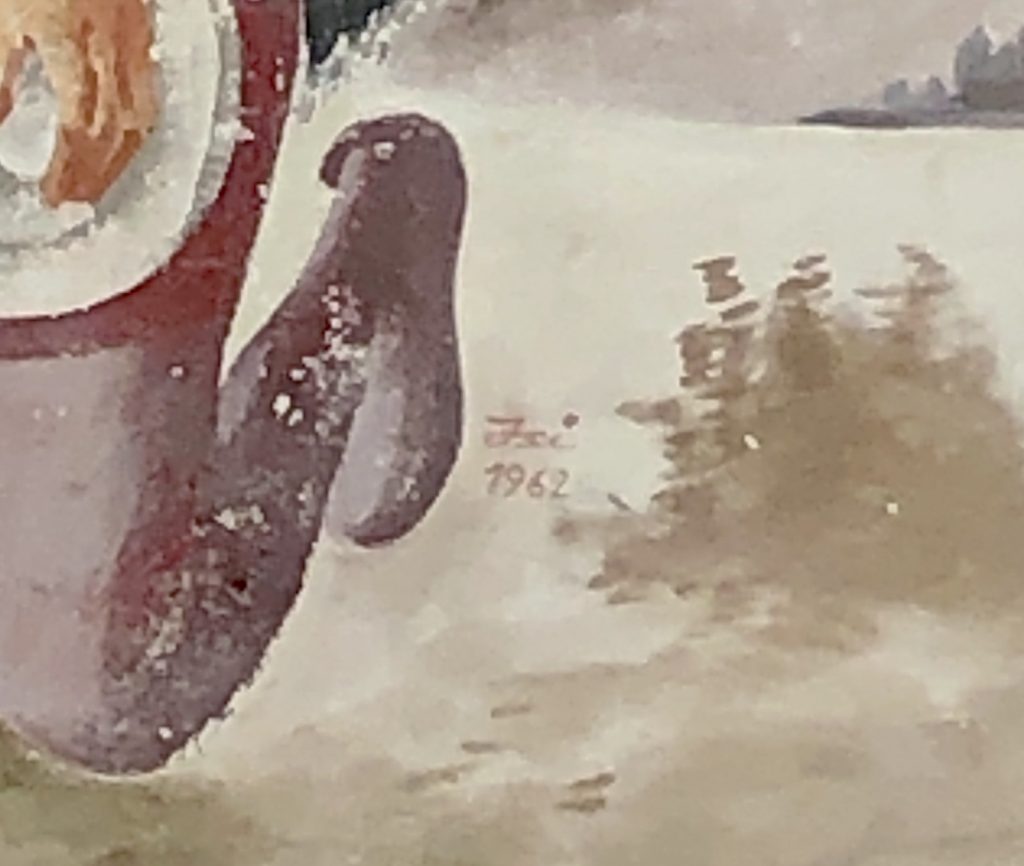
Isidor (“Isi”) Winterholler was born on April 17, 1907.

According to the Garmisch-Partenkirchen tourist office’s plaque located at Bankgasse 5, the “zum Winterholler Isi” House, Isidor Winterholler was a painter from Unterwindach near Landsberg, who obtained the building on Bankgasse in 1939 and established an inn on the ground floor.54

He died — 59 years to the day he was born — on April 17, 1966.55

Franz Seraph Zwinck

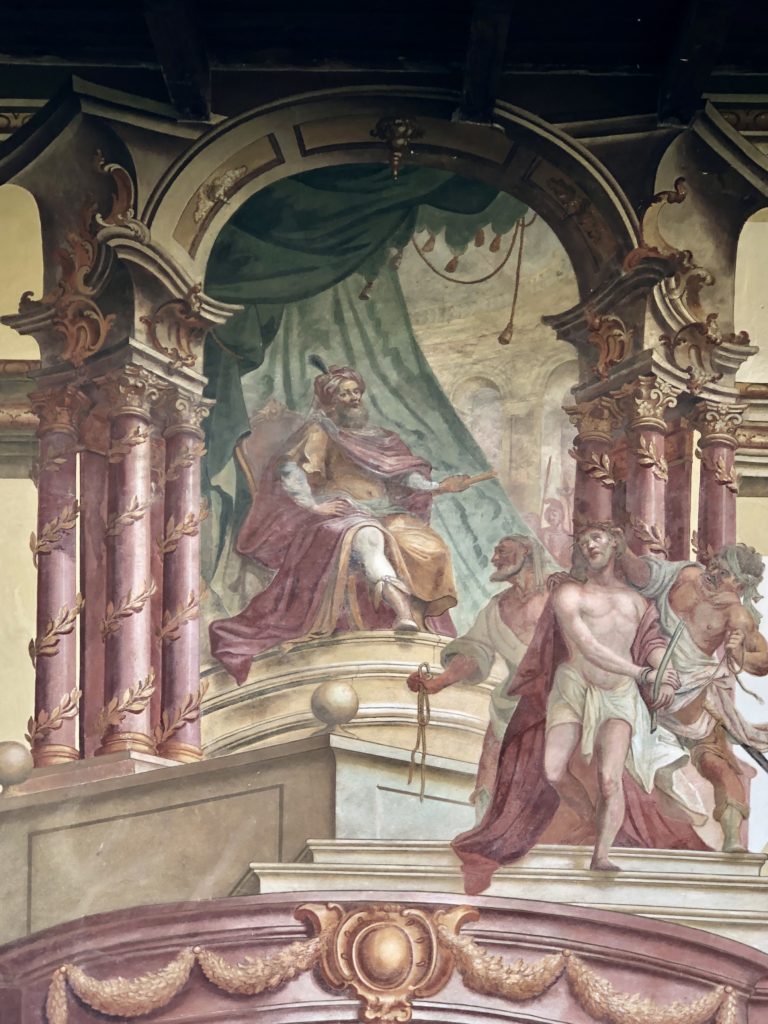
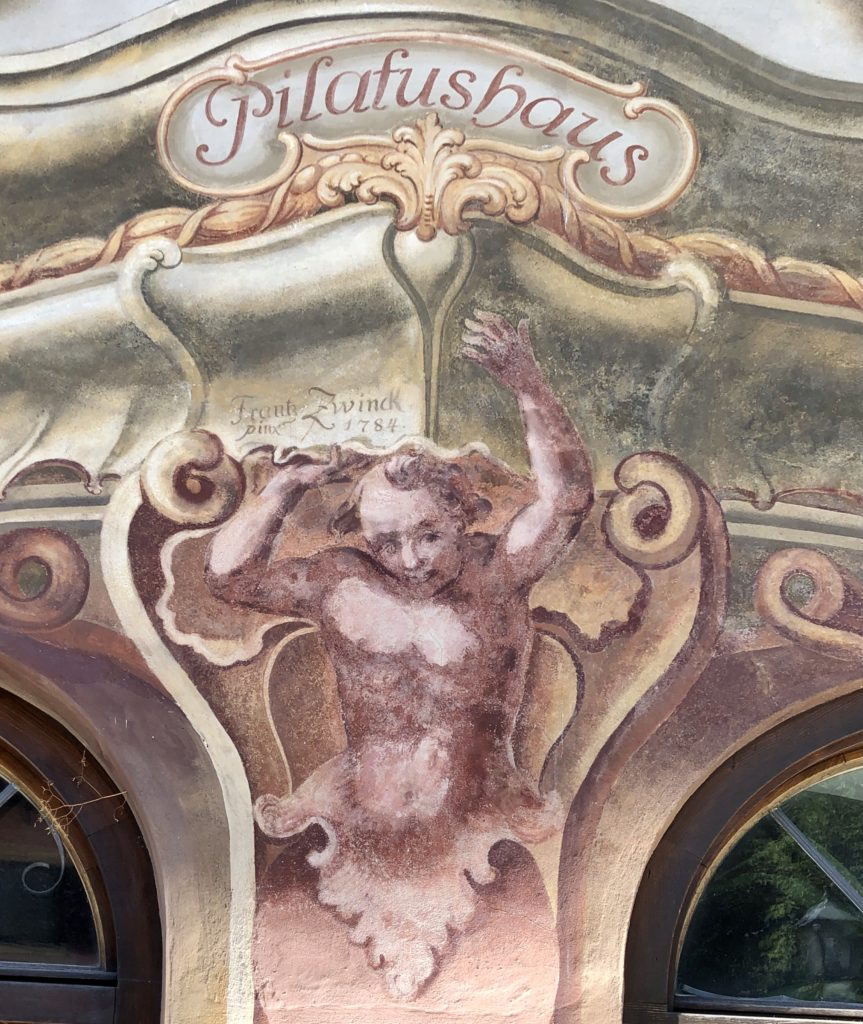
Franz Seraph Zwinck, the original “Lüftlmaler,” was born in Oberammergau in 1748.

While there is no surviving documentary evidence from his lifetime, legend has it that Franz Zwinck learned about painting first from his father, Johann Josef Zwinck, himself a painter who preserved oil and church paintings, then helped with the frescoes in the Ettal Abbey, and finally at the Augsburg Painting Academy, which was then under the direction of Matthäus Günther.56

Zwinck died in 1792.

In the death register of Oberammergau it is written under May 29, 1792: “In the 44th year of his life, Franz Seraph Zwinck, a painter not to be ignored, ill for a long time and often provided with the sacraments of the holy church, finally put an end to his painting.”57

  1. "Picture Houses," Time Magazine, August 25, 1952.
  2. "Opulent war nur die Phantasie: Ein Gespräch mit Moidele Bickel." Kostümbild: Lektionen 6, Theater der Zeit, 2016: "Ich habe die Schule vorzeitig abgebrochen, nicht mal Abitur gemacht. Eines Tages habe ich zu meinem Vater gesagt, diese Nonnen, die sind mir zu blöd, ich kann das nicht mehr aushalten. Da hat er gesagt: Musst du ja nicht, kommst du eben mit mir. Und dann bin ich mit ihm seine Aufträge erledigen gegangen. Er hat Hausfassaden und Deckenbilder gemalt."
  3. "Opulent war nur die Phantasie: Ein Gespräch mit Moidele Bickel." Kostümbild: Lektionen 6, Theater der Zeit, 2016: "Dann kommt diese Nähe zur Malerei vom Vater? Die kommt eindeutig von meinem Vater, aber auch aus dem Widerstand gegen ihn. Ich wollte es natürlich nicht so machen wie er.  Ich wollte es ganz anders machen."
  4. "Opulent war nur die Phantasie: Ein Gespräch mit Moidele Bickel." Kostümbild: Lektionen 6, Theater der Zeit, 2016: "Dann durfte ich drei Semester Malerei studieren.  Das war in den späten Fünfzigern. [...] Die Münchner Akademie.  Ich hatte Glück, weil ich beim Oberberger war."
  5. "Opulent war nur die Phantasie: Ein Gespräch mit Moidele Bickel." Kostümbild: Lektionen 6, Theater der Zeit, 2016: "Das war in München.  Da bin ich zum ersten Mal überhaupt ins Theater gegangen.  Also richtiges Theater, nicht Peterchens Mondfahrt oder so.  Da habe ich die Sachen von Kortner gesehen und mir gedacht: Das will ich auch haben.  Ich habe mir überlegt, was ist am nächsten dran.  Das war Bühnenbild, also bin ich in die Bühnenbildklasse in München an der Akademie, die von Professor Helmut Jürgens geleitet wurde.  Er hat immer die Ausstattungen für die Opern von Orff gemacht, die ich hasste wie die Pest.  Zu ihm bin ich gegangen und habe gefragt, ob er mich nimmt. Er hat zu den Mädchen, die er nicht wollte, immer gesagt: Werden Sie Krankenschwester, das ist besser.  Und zu mir hat er gesagt: Gehen Sie zurück zu Ihrem Vater, da verdienen Sie wenigstens Geld."
  6. Meisenberger, Raimund. "Die Anfänge der Kostümbildnerin Moidele Bickel in Passau und Eggenfelden." Passauer Neue Presse (PNP.de), 20 May 2016, https://www.pnp.de/nachrichten/kultur/Die-Anfaenge-der-Kostuembildnerin-Moidele-Bickel-in-Passau-und-Eggenfelden-2080250.html. Accessed 5 Nov 2020: "Der Ursprung dieser Karriere liegt am Fürstbischöflichen Opernhaus Passau, wie Stadtheimatpflegerin Gisa Schäffer-Huber erklärt. Demnach kam Moidele Bickel mit ihrem Vater Heinrich Bickel − beide gelernte Maler und Restauratoren − in die Dreiflüssestadt zur Sanierung des Stadttheaters, die von 1959 bis 1961 vonstatten ging."
  7. "Opulent war nur die Phantasie: Ein Gespräch mit Moidele Bickel." Kostümbild: Lektionen 6, Theater der Zeit, 2016: "Dann sollte das klassizistische Opernhaus in Passau restauriert werden. […] Mein Vater hat diese Arbeit angenommen, weil es dort auch eine Decke gab, deren ursprüngliche Deckenmalerei aber verloren war.  Zur gleichen Zeit, die Eröffnung des Theaters war schon ganz nahe, wurde dort Figaros Hochzeit geprobt.  Ich bin zu dem Regisseur gegangen und habe ihn gefragt, ob ich nicht dableiben kann.  Sie haben mich genommen. Da war ich dann plötzlich Bühnenbildner."
  8. Meisenberger, Raimund. "Die Anfänge der Kostümbildnerin Moidele Bickel in Passau und Eggenfelden." Passauer Neue Presse (PNP.de), 20 May 2016, https://www.pnp.de/nachrichten/kultur/Die-Anfaenge-der-Kostuembildnerin-Moidele-Bickel-in-Passau-und-Eggenfelden-2080250.html. Accessed 5 Nov 2020: "Moidele Bickel war zwischen 1964 und 1966 regelmäßig als Bühnenbildnerin in Passau und Landshut beschäftigt und hat in dieser Zeit unter anderem die Bühnenbilder zu ,Die Großherzogin von Gerolstein‘, ,Königskinder‘, ,Don Pasquale‘ und ,Der Menschenfeind‘ gemacht."
  9. "Opulent war nur die Phantasie: Ein Gespräch mit Moidele Bickel." Kostümbild: Lektionen 6, Theater der Zeit, 2016: "In Passau und Landshut habe ich ein Jahr lang Bühnenbilder gemalt, ungefähr dreizehn.  Also so jeden Monat eins. [...] Es gab nichts anderes.  Es waren Paravents, die musste man zusammenklappen, damit es in den Lastwagen passte.  Sie haben ganz Niederbayern bespielt - in Wirtshäusern, in Kinos.  Da man dort nur nachts arbeiten konnte, weil sie natürlich keinen Malsaal hatten, haben sie mir die Leinwände immer abends nach der Vorstellung auf die Bühne gelegt und ich habe nachts durchgemalt."
  10. "Opulent war nur die Phantasie: Ein Gespräch mit Moidele Bickel." Kostümbild: Lektionen 6, Theater der Zeit, 2016: "Ich kannte Peter Stein aus München, aus der sogenannten Studentenzeit.  Da war er Regieassistent bei Kortner.  Wir hatten im Studententheater etwas zusammen gemacht.  Ich hörte von der Gründung der Schaubühne in Berlin.  Ich bin hingefahren und habe gesagt: Ich will auch.  Und Peter hat gesagt: Ja, warum eigentlich nicht?"
  11. "Berliner Kostümbildnerin Moidele Bickel gestorben." Berliner Morgenpost, 18 May 2016, http://www.morgenpost.de/kultur/article207575443/Berliner-Kostuembildnerin-Moidele-Bickel-gestorben.html. Accessed 5 Nov 2020: "1970 war die gebürtige Münchnerin nach Berlin gezogen, um an der Schaubühne 22 Jahre lang die Inszenierungen Peter Steins mit Kostümen auszustatten."
  12. "Moidele Bickel Biografie." filmportal.de, https://www.filmportal.de/person/moidele-bickel_cffa077886c1441fab105fa5f69e2202. Accessed 5 Nov 2020: "Ihre Kostümgestaltung bei Eric Rohmers "Die Marquise von O." (1976) bringt ihr einen British Academy Award (BAFTA) ein. 1994 und 1995 gewinnt sie in Frankreich zweimal in Folge den "César": 1994 für Claude Berris "Germinal", im Jahr darauf für Patrice Chéreaus "Die Bartholomäusnacht", für den sie auch für den Oscar nominiert wird."
  13. Lieber, Leah. "Re: Question about your costume design work under the pseudonym 'Bernadette Villard'". Message to the author. 5 November 2020. Email: Moidele Bickel "did NOT work on Germinal and did NOT won an award for this movie. The best about the truth is to see the credit of the movie itself and not through internet which is full of mistakes."
  14. Rüdiger Schaper, “Sie zog alle an,” Der Tagesspiegel, 18 May 2016, accessed 5 July 2025. https://www.tagesspiegel.de/kultur/sie-zog-alle-an-3722869.html.
  15. Franz Wörndle (town archivist, Marktarchiv Garmisch-Partenkirchen), “Re-4: Fwd: Re-2: Homepage Lüftmaler,” e-mail message to the author, 22 September 2020. "Burges, Christa (Johanna); Malerin, Zeichnerin, Freskantin, Graphikerin, Linol- und Holzschneiderin, Porträts, Figürliches, Landschaften, Holzreliefs; *14.7.1924 Dresden – †19.3.1990 (Partenkirchen Klinikum, Grab in Garmisch); B. stammt aus einer Hugenottenfamilie; 1941-45 Studium an der Staatlichen Akademie der bildenden Künste in Dresden bei M.Claus (Graphik und Illustration), ab Oktober 1942 bei G.Siebert (Porträt und Tafelbild) und bei H.Hanner (Meisterschülerin, Komposition, Wand- und Tafelbild); 1942 und 1944 Akademiepreise".
  16. Franz Wörndle (town archivist, Marktarchiv Garmisch-Partenkirchen),

    “Re-4: Fwd: Re-2: Homepage Lüftmaler,” e-mail message to the author, 22 September 2020. "B. lebte seit März 1945 in Garmisch-Partenkirchen, zuletzt in Gar-misch, Fichtackerstraße 23."

  17. Franz Wörndle (town archivist, Marktarchiv Garmisch-Partenkirchen),
    “Re-4: Fwd: Re-2: Homepage Lüftmaler,” e-mail message to the author, 22 September 2020. "[N]achkriegsbedingte Tätigkeit im Kunsthandwerk (Spielzeugschnitzerei, Scherenschnitte), dann Werbegraphikerin; Gewinnerin von internationalen Wettbewerben für Entwürfe von Münzen, Medaillen und Plaketten; Buchillustrationen und Einbandentwürfe für Verlage".
  18. Nelly Louise Brandenburg, Prinzessin Attaleia: Ein Märchen für Kinder (Köln: Schweitzer, 1963). “Mit farb. Bildern von Christa J. Burges”
  19. K. Uhl, ed. Zur Geschichte der Kinderklinik und Rheumakinderklinik in Garmisch-Partenkirchen 1932–1986 (Garmisch-Partenkirchen: Selbstverlag der Klinikum, 1986). “Umschlag­gestaltung Christa J. Burges”.
  20. Franz Wörndle (town archivist, Marktarchiv Garmisch-Partenkirchen),
    “Re-4: Fwd: Re-2: Homepage Lüftmaler,” e-mail message to the author, 22 September 2020. "Studienreisen nach Frankreich und Italien; Mitglied des KBG; Gründerin des Kunst Seminars Werdenfels; „Großformatige Linolschnitte demonstrieren ihre graphische und illustrative Begabung, Farbreliefs lehnen sich an folkloristische Holzschnitzerei-en an, während ihre Porträtstudien fundierte akademische Schulung verraten.“ (GPT 1973, »R.Härtl); „Das pädagogische Geschick, das man aus ihren Worten heraushört, beweist die Künstlerin aber auch in ihren gut besuchten Kunsthandwerk- und Malkursen bei der hiesigen vhs. Dort versteht es Christa Burges, mit viel Einfühlung in ihren Schützlingen verborgene künstlerische Begabungen zu wecken und ihnen so zu einem sinnerfüllten Leben zu verhelfen. Aber dazu ge-hört Handwerk. So müssen die Schüler in oft mühsamer Arbeit die Techniken der Farbzubereitung und -mischung, der Grundierung und des Vergoldens, des Gipsschneidens und Schnitzens lernen, um ihre Ikonen und Hinterglasbilder sauber und materialgerecht gestalten zu können. ... Ihren Mal- und Zeichenkurs bezeichnet die Künstlerin ›als Schule des Sehens‹. Diese Erziehung zum richti-gen Sehen, zum ›Handwerk mit den Augen‹, wie es die Malerin selbst nennt, geschieht durch das Zeichnen vor dem Motiv selbst: Licht- und Schattenwirkungen werden ebenso genau studiert wie Linie und Form des Objekts. Dabei be-treibt Christa Burges ›eine Art Pädagogik durch das Hintertürchen‹: Je nach individueller Veranlagung und Begabung werden die Schüler behutsam gelenkt oder durch konstruktive Kritik auch mal bewußt ›geschockt‹.“ (GPT 1974, »R.Härtl); „Durch ihre Lehrtätigkeit an der Volkshochschule und ihr anstecken-des Temperament hat sie viele Menschen für die Kunst geöffnet und zu kreativer Freizeitgestaltung motiviert. Die gebürtige Dresdnerin studierte dort an der Staatlichen Akademie der bildenden Künste und legte 1945 das Staatsexamen ab. Lange Jahre war sie bei Verlagen für die Illustrationen in Kinder- und Jugendbücher zuständig, entwarf Münzen und Medaillen sowie Kinderspielzeug. 43 Jahre war sie zugleich freischaffende Malerin und Grafikerin. Ein Bild in der Turnhalle der Gröbenschule stammt von ihr, sie malte Fresken im Kloster Schouls-Tarasp und an hiesigen Häusern, organisierte Ausstellungen. Seit 1967 war sie an der vhs als (dienstälteste) Kursleiterin tätig (Aktmalen, Aquarelle, Bauern- und Hinterglasmalerei). 1985 übernahm sie den ›Werdenfelser Künstlerbund‹, der 1986 in ›Werdenfelser Künstlergilde‹ umgetauft wurde.“ (GPT 1990); Ausstellungen: 1969/83 Arnsberg Sauerland-Museum, Dresden, München Haus der Kunst; Garmisch-Partenkirchen, 1996, zuletzt 2002, Gedächtnisausstellung; Werke, Fresken: Garmisch: 1955, Alpspitzwellenbad „Garmisch-Partenkirchen im Jahreslauf“; 1966, Frühlingstraße 16 „Hubertuslegende“; 1969, Loisachstraße 29 „Vogelpredigt des hl.Franziskus“; 1969, Brauhausstraße 7, kath. Kindergarten St. Martin „Die 4 Jahreszeiten und der Martinszug der Kin-der“; 1969, Eibseestraße 33 „Schäferszene“; 1971, Fichtackerstraße 23 „St. Christophorus“; 1973, Osterfelder-Bahn, Talstation „Berge“, Bergstation „St. Bernhard“; 1974, Thomas-Knorr-Straße 17 „hl.Barbara“; 1977, Maximilianstraße 31, Volksschule Gröben und Sportzentrum „Leichtathletik“ (»E.M.Lang); 1979, Alpspitzstraße 6 „Ornamentfassade“; 1981, Höllentalstraße 48, Hotel Staudacherhof „Hll. Ursula und Franziskus“; Waxensteinstraße 13 „Tiere“; Garmisch, Friedhof, 1961 „hl.Antonius“ (an ihrem Grab); 1968, Grainau, Waxensteinstraße 22 „hl.Franziskus“; 1970, Untergrainau Wies, Haus Köhler „Erkerfries“; 1973, Am Krepbach 16 „Till Eulenspiegel“; 1973, NATO-Schule, Weltfriedenskapelle: „So schuf sie in der Kapelle der US-Schule Oberammergau einen Fresken-Zyklus, der sie fast ein Jahr lang beschäftigte. Dort hat sie religiöse Aussage (der Auferstehende über dem Regenbogen z.B.) mit dem Appell ge-gen Gewalt, Leid und Unrecht verknüpft. Das große Fresko flächig linearen Stils zeigt eine bemerkenswerte geistige Durchdringung.“ (GPT 1974, »R.Härtl); Partenkirchen: 1968, Meisenstraße 18 „St. Leonhard“; 1970, Schönbergstraße 4 „Wachsen-Leben-Schaffen“; MGP: 1965, Kreidezeichnung „Kinderbildnis“, Gouache „Im Beatschuppen“, Gemälde „Musizierendes Kind“ (1965 erworben, Abbildung GPT), 1970 „Bürgermeister August Vogel“ (Abbildung GPT 14.3.1970) und 1980 „Bürgermeister »Josef Zwerger“ (Abbildung GPT 5.1.1980); 1972, Garmisch, Marienplatz, 2 Panoramakarten „Sommer“ und „Winter“ (Abbildung GPT 16.5.1972); Olympia-Abzeichen für die Olympischen Winterspiele 1956 in Cortina; Literatur: MAGP, Abendzeitung München März 1964, Westfälische Rundschau 14.1.1969 (Porträt); Westfalenpost 18.5.1983 (Porträt), GPT 14.12.1965 (Abbildung)/Juni 1971 (Porträt)/ 15.6.1973/ 5.8.1974 (Porträt)/ 16.9.1975 (Abbildung)/5.1.1980/ 20.6.1985 (Abbildung)/ 22.3.1990/ 17.1.2002/ 23.1.2002 (Selbstporträt), KB 10.5.1996/ 16.1.2002 (Abbildung); Mg: CJB; www".
  21. Malerei Vergolderei Ertl. “Über uns – Firmenhistory.” Accessed July 5, 2025. https://www.malerei-ertl.de/%C3%BCber-unscc2c8103.
  22. Margot Schäfer. “Garmisch-Partenkirchen: Im Polznkaspar-Haus kann man die Sommerferien über Kunst von Otto Ertl bewundern.” Kreisbote (Garmisch-Partenkirchen), August 12, 2022. Accessed July 5, 2025. https://www.merkur.de/lokales/garmisch-partenkirchen/kreisbote/garmisch-partenkirchen-im-polznkaspar-haus-kann-man-die-sommerferien-ueber-kunst-von-otto-ertl-bewundern-91712373.html.
  23. Malerei Vergolderei Ertl. “Über uns – Firmenhistory.” Accessed July 5, 2025. https://www.malerei-ertl.de/%C3%BCber-unscc2c8103.
  24. “Traueranzeige ‘Otto Ertl.’” trauer.merkur.de. Published January 17, 2023. Accessed July 5, 2025. https://trauer.merkur.de/traueranzeige/otto-ertl.
  25. Wolfgang Kaiser, “Tradition und Moderne: Die zwei Gesichter des Gerd Ester,” Garmisch-Partenkirchner Tagblatt (online at merkur.de), 2 May 2009, accessed 5 Jul 2025. https://www.merkur.de/lokales/regionen/tradition-moderne-zwei-gesichter-gerd-ester-265117.html.
  26. “Carolin Reiber mischt sich unters Volk,” merkur.de, 13 Dec 2012, accessed 5 Jul 2025. https://www.merkur.de/lokales/garmisch-partenkirchen/carolin-reiber-mischt-sich-unters-volk-2663872.html.
  27. Andreas M. Bräu, Kulinarische Geschichten aus dem Werdenfelser Land,(Sutton, 2013). “Illustrationen von Gerhard Ester”.
  28. “Traueranzeige ‘Gerhard Ester,’” trauer.merkur.de, posted 14 Apr 2018, accessed 5 Jul 2025. https://trauer.merkur.de/traueranzeige/gerhard-ester.
  29. Wörndle, Franz. “Re: Questions about Lüftlmalereien / Fragen über Lüftlmalereien". Message to the author. 13 November 2020. E-mail: "Gemeinhardt, Karl (Hermann); Maler, Freskant, Landschaften, Berge, Tiere, Porträts, Blumen, Akte; *1.2.1905 Stecken/Sudetenland – †23.9.1985 Partenkirchen, Ludwigstraße 38; in München tätig; seit 1937 lebte er in Garmisch-Partenkirchen, um 1953 in der Von-Steuben-Straße 15, Von-Brug-Straße, tätig; 3 ½ Jahre als Porzellanmaler in der Kunstabteilung der Porzellan-Manufaktur Rosenthal in Selb tätig; 1925-30 sieben Semester Studium an der ABK München, Meisterschüler von A.Jank (Tiermalerei); Mitglied des Werdenfelser Künstlerbundes (1967-85 Vorsitzender), der WEK und im KBG; „Hermann Gemeinhardt verbindet in sattfarbenen Landschaften naturalistische Gestaltung mit impressionistischer Lichtmalerei, besonders gut etwa bei ›Im Moor‹ mit dem Reichtum gut abgestufter Tonwerte.“ (GPT 1975, »R.Härtl); „Mit liebevoller Beobachtung und feinem Gespür für ihre Eigenart schildert er Katzen, Hunde, Hühner, Pferde und Kühe mit dem Auge des geborenen Malers, dem keine Nuance ihres farbigen Erscheinungsbildes entgeht. So schuf er im Laufe der Jahre zahlreiche harmonische Tierkompositionen, die Gemüt und Auge des Betrachters gleichermaßen ansprechen. ... In seinen Ansichten des Wettersteins fasziniert den Künstler weniger die schroffe Monumentalität und Wildheit der Formationen, als vielmehr das Spiel von Licht und Farbe.“ (GPT 1985, »R.Härtl); Gedächtnisausstellung in Garmisch-Partenkirchen; Werke: Gemälde „Alpspitze“, „Stiefmütterchen“, „Pferde und Kühe auf der Weide“, „Waldstudie“, „Abendsonne am Eibsee“ und „Guter Nachwuchs“ (MGP); Fresko Partenkirchen, Bischofweg; Literatur: Kunst in Eger, Langen/Müller Verlag, München; MAGP, GPT"
  30. “Traueranzeige ‘Josef Guggemoos’,” trauer.merkur.de, posted 8 December 2018, accessed 5 July 2025, https://trauer.merkur.de/traueranzeige/josef-guggemoos.
  31. Franz Wörndle “Re-4: Fwd: Re-2: Homepage Lüftmaler"(Marktarchiv Garmisch-Partenkirchen), e-mail to the author, 22 September 2020. "Guggemoos, Josef (Sepp); Freskant; *1928 Partenkirchen; Vater von »Toni G.; Cousin von »Hans Guggemoos; ab 1946 Malerlehre bei »H.Bickel; Werke, Partenkirchen: Ludwigstraße 7 und 22; 1967, Schnitzschulstraße 7, Sgraffito „Rehe“; Literatur: MAGP, KB 25.6.2008 (Porträt, Abbildung)".
  32. Michael Ertl, “More Informations Lüftlmalerei,” e-mail to the author, 13 April 2020. "My father told me that Guggemoos learned to paint plants from my grandfather. With this knowledge, he then tried to start to paint the Lüftlmalerei."
  33. Ertl, Michael. “More Informations Lüftlmalerei". Message to the author. 13 Apr 2020. E-mail: "On the spelling of 'Guggemoos.' You will find a small stroke or swish above the 'u' in various German words that are written in handwriting. This is not an 'ü'! In the old German Handwrite (Kurrentschrift) the 'n' and the 'u' are identical. To avoid confusion, a small stroke or swish was made above the 'u' (ῠ or ῡ = u)."
  34. Wörndle, Franz. “Re-4: Fwd: Re-2: Homepage Lüftmaler". Message to the author. 22 Sep 2020. E-mail: "Hülsmann, Eberhard sen.; Malermeister, Maler, Graphiker, Freskant, Blumen; *10.5.1913 (16.5.1915?) – †29.4.1995 Partenkirchen; ebenda, Ludwigstraße 29 und Rathausplatz 13, tätig; Vater von »E.H. jun.; Mitglied im Verband der Bayerischen Krippenfreunde; Werke, Fresken in Partenkirchen: „Zur schönen Aussicht“, Brunnhäuslweg „Mesma“, Faukenstraße, Ludwigstraße 55 (1974); Römerstraße 2; Panorama, Nebenhaus „Sonnenuhr“; Literatur: GPT, A1927-53, MAGP, Adam/Jocher (Abbildung), DBK/295, Meider (Abbildung)"
  35. Wörndle, Franz. “Re-4: Fwd: Re-2: Homepage Lüftmaler". Message to the author. 22 Sep 2020. E-mail: "Hülsmann, Eberhard jun.; Maler, Graphiker, Freskant, Panoramen, Krippenhintergrundmaler; *22.2.1937; Partenkirchen; seit 1967 Mitglied im Verband der Bayerischen Krippenfreunde; Werke: 1961, Fresko, Partenkirchen, Ballengasse 4 (Abbildung Goldenes3); 1972, Grainau, Schwimmbad, Innengestaltung; 1980, Panorama Grainau, am Rathaus; Literatur: Rehm1, Werdenfelser Krippenfreunde, Goldenes3, DBK/279".
  36. Wörndle, Franz. “Re-4: Fwd: Re-2: Homepage Lüftmaler". Message to the author. 22 Sep 2020. E-mail: "Kaiser, Max (Maximilian); Bildhauer, auch Krippen, Freskant; *6.1.1903 Aising/Rosenheim – †2.7.1976 Partenkirchen, Ballengasse 8; Lehre an der Schnitzschule Partenkirchen; Studium an der Kunstschule in Nürnberg, K. finanziert sein Studium als „Ornamentik-Schnitzer“ in einer Möbelfabrik; dann in Dresden als Restaurator tätig; seit Anfang der 1930er Jahre „Atelier für dekorative Plastik“ in Partenkirchen, Ballengasse 8: „In seinem Atelier ... fertigte Max Kaiser, ein emsiger und extrem stilsicherer Künstler, zusammen mit insgesamt drei Gehilfen (die heute längst hochangesehene und weit über die Grenzen des Werdenfelser Landes hinaus bekannte Bildhauer sind) schier unzählige Werke aller Art und in fast jedem Stil: Von der bescheidenen Türverzierung bis zum Taufstein im Gotteshaus, von prunkvollen Stuckarbeiten bis zur Krippenfigur, von der Rokokomadonna über den Orgelprospekt bis zur kompletten Kirchenausstattung.“ (»W.Kaiser); 1935 Heirat mit Anna Aumayr, Tochter des Goldschmiedes »Josef A.; K. ist 1940-45 im Krieg und anschließend in Gefangenschaft; Zusammenarbeit mit »Heinrich Bickel, Entwürfe für Figurengruppen; „Die Kunst Max Kaisers vereint in schier idealer Weise bildhauerisches Handwerk und hohes künstlerisches Können.“ (Kölbl); „Max Kaiser war ein außerordentlich bescheidener Künstler, aufgewachsen in der großen bildhauerischen Tradition des Werdenfelser Landes, der unter Kennern der Kunst nicht vergessen sein wird.“ (W.Kaiser); Werke: 1948, Partenkirchen, Pfarrkirche, Madonna am Hochaltar, nach der Riemenschneider-Madonna von Creglingen (Abbildung Kölbl) und die Altarflügel mit Relief-Szenen aus dem Leben Jesu (»M.Berger); einige Figuren der „»Silberer-Krippe“ in Partenkirchen, WFM (»Georg Anderl); Partenkirchen, Friedhof, „Christus“ (Gemeinde-Pfarrergrab); Fresko „St. Anna“, Partenkirchen, Ludwigstraße 1; Partenkirchen, Schornstraße „Christus“; um 1930 an der Restaurierung des Dresdener Zwingers beteiligt; Literatur: Rehm1, Dr1930, A1937-53, Vignau, De, Fischer2, Kölbl, Härtl1, Adam/Jocher; Wolfgang Kaiser, Der Bildhauer Max Kaiser, Manuskript, 1997".
  37. Wörndle, Franz. “Re-4: Fwd: Re-2: Homepage Lüftmaler". Message to the author. 22 Sep 2020. E-mail: "Lang, Hermann; Architekt BDA; in München, Ungererstraße 32, tätig; Werke, Partenkirchen: Um 1910 mit »F.Rank und »P.Danzer Erweiterungspläne für das Rathaus Partenkirchen, nicht ausgeführt; 1913/14, Münchner Straße 65 „Neuer Friedhof ... Friedhofskapelle mit monumentaler Zwiebelkuppel ... angeschlossene erdgeschossige Trakte mit Schindeldächern (Wärterwohnung, Gruftarkaden).“ (BLD), mit Beratung von »H.Grässel; 1918-20, Pläne für Kurhausprojekt, von der Regierung abgelehnt; 1923, Dreitorspitzstraße 21 „Landhaus im alpenländischen Heimatstil, mit Hochlaube, Balkon, Zierbund und reicher Fassadenmalerei ...“ (BLD); 1927, »Prof.-Wackerle-Straße 8 „Haus Zufriedenheit“: „Der ungewöhnliche Name übrigens ist am Erker im Bild von »Heinrich Bickel verewigt. Auf wen der erbauende Sinnspruch zurückgeht, ist freilich unbekannt. ›Sollt ich aus allen Gütern wählen, so wählt ich mir Zufriedenheit. Mein Glück soll keine Neider quälen, genug, wenn es nur mich erfreut.‹“ (GPT 6.4.1999, Abbildungen), „Landhaus im alpenländischen Heimatstil, mit Giebelbundwerk, Lauben und reicher Fassadenmalerei [1948/49 „Anbetung der Hirten“] von Heinrich Bickel ...“ (BLD); 1928, Partenkirchen, Dreitorspitzstraße 53 „Landhaus im alpenländischen Heimatstil, mit Hochlaube, Balkon und Eckerker ...“ (BLD); Ludwigstraße „Schmöger-Haus“; Literatur: Dr1930, Ostler3, BLD, GPT 6.4.1999, Adam/Jocher".
  38. Alois Schwarzmüller, “Maler, Bildhauer, Künstler in Burgrain,” Burgrain – der ‘dritte Ortsteil’ von Garmisch-Partenkirchen 1939–1989, accessed 5 July 2025, https://www.gapgeschichte.de/burgrain_texte/maler_und_kuenstler.htm.
  39. Wörndle, Franz. “Re-4: Fwd: Re-2: Homepage Lüftmaler". Message to the author. 22 Sep 2020. E-mail: "Marchlowitz, Kurt; Dekorationsmaler, Maler, Landschaften, Freskant; *2.12.1913 Oranienburg – †30.10.1998 Zichron-Yaaqov/Israel; in Berlin Kindheit und Schule; Lehre als Schriftenmaler und Hinterglasvergolder; seit 1933 im Werdenfelser Land, erst in Krün (Reichsarbeitsdienst), dann Geschäftsgründung in Partenkirchen, Hauptgebiet Möbelmalerei und Fassungen von Holzplastiken; seit Februar 1939 lebte er in Farchant, Dorfbachweg 3; Vater von »Peter M.; 1939-45 im Zweiten Weltkrieg; danach Malergeschäft in Farchant: „Zu seinen künstlerischen Tätigkeiten gehörten u.a. Lüftlmalerei, Sgraffiti, Restaurieren alter Möbel und Bilder, Gemälde in Öl auf Leinwand, Pastellmalerei, Enkaustik (Wachsmalerei), Aquarelle und Temperabilder, Mosaike mit Muranoglas, Vergolden von Holzplastiken, Fassadengestaltung usw. Viele seiner Werke sind im gesamten Landkreis Ga.-Pa. noch zu bewundern – z.B. Kongreßzentrum, Spielbank, Volksbank in Ga., Kurgästesaal und VR-Bank in Farchant usw.“ (H.Filser, WFM); April 1993 Übersiedelung nach Israel; Ausstellung: 2003, Partenkirchen, WFM; Werke: Farchant: Viele im Rathaus und im Gasthof Kirchmayer; Garmisch, Sammlung J.Ostler; Gernweg 2, Fresko „Mutter Gottes“ datiert 1968; Alpspitzstraße 4, bemalte Hausbänke und Schränke; Ettal, Kloster, Innenarbeiten; Garmisch, Am Kurpark 13 Fresko; Garmisch, Kongresszentrum, Innenarbeiten; Partenkirchen, Hauptstraße 21, Fresko „Bauer mit Stier“; Saulgrub, Raiffeisenbank, Fresko; 1984, Gemälde „Alter Wirt in Farchant“ (Abbildung forcheida 1992); Literatur: A1939-58, forcheida November 1991/ November 1992; (freundliche Auskunft von Herrn H.Filser, WFM); Mg: KM".
  40. Wörndle, Franz. “Traub". E-mail to the author 20 October 2020. "Maler, Landschaften, Kunstgewerbemaler, Freskant; in Partenkirchen, Sankt-Anton-Straße 3 und “Prof.-Wackerle-Straße 13, tätig; um 1938 Mitglied der Künstlerkameradschaft in Garmisch-Partenkirchen; „Die Winterlandschaften Matzens (‘Höfelebauer’) geben die Natur genau gesehen wieder.” (GPT 1975, “R.Härtl); Ausstellung: 1975, Garmisch; Werk: Mit “Karl Traub, Partenkirchen, Kohlstattstraße „hl.Korbinian”; Literatur: MAGP, A1927-53, GPT 11.1.1975".
  41. “The Artist – Biographic.” nardiello.net. Accessed July 5, 2025. https://nardiello.net/home/home-ing.html.
  42. “Vita – Michele Nardiello.” nardiello.net. Accessed July 5, 2025. https://nardiello.net/Nardiello-de/vita.html.
  43. Angela Mazzotta. “Nella luce di Caravaggio la mia ispirazione.” GravinaLife, August 5, 2019, accessed 5 July 2025. https://www.gravinalife.it/eventi/nella-luce-di-caravaggio-la-mia-ispirazione-mostra-omaggio-a-gravina-dell-artista-michele-nardiello/.
  44. “The Artist – Biographic.” nardiello.net. Accessed July 5, 2025. https://nardiello.net/home/home-ing.html.
  45. http://www.gewoelbegestaltung.de/
  46. Rudolf Tomaschek, “Kunstwerk der Heiligen Elisabeth ziert Pfarrkirche,” Merkur (Starnberg), 2 March 2010, accessed 5 July 2025, https://www.merkur.de/lokales/starnberg/landkreis/kunstwerk-heiligen-elisabeth-ziert-pfarrkirche-654007.html.
  47. Josef Hornsteiner, “Bozner Markt 2012: Organisatoren rechnen mit 100 000 Besucher,” Merkur (Mittenwald), 9 June 2011, accessed 5 July 2025, https://www.merkur.de/lokales/garmisch-partenkirchen/mittenwald-ort29073/bozner-markt-2012-organisatoren-rechnen-100000-besucher-1278847.html.
  48. “Die Alpen von oben 07: Von Mittenwald ins Allgäu,” Fernsehserien.de, accessed July 5 2025, https://www.fernsehserien.de/die-alpen-von-oben/folgen/07-von-mittenwald-ins-allgaeu-382327.
  49. Helga Albrecht, “Vor 75 Jahren starb der Maler Carl Reiser,” Kreisbote (Garmisch-Partenkirchen), 23 June 2025, accessed 5 July 2025. https://www.kreisbote.de/lokales/garmisch-partenkirchen/vor-75-jahren-starb-der-maler-carl-reiser-92535779.html.
  50. Wildegans, Michael. “Re: Frage zum Wandbild an der Außenwand Ihres Gebäudes in Garmisch-Partenkirchen". Message to the author. 1 April 2020. E-mail: "Der Maler hieß Traub  er war in Garmisch Partenkirchen ansässig. Neben den üblichen Malerarbeiten bemalte er auch Bauernschränke".
  51. Wagner, Rainer. "Re: Fragen zu Ihren Lüftlmalereien". Message to the author. 2 May 2021. Email: "BIOGRAPHIE<br>1945 geboren in Oberammergau<br>Lehre als Fassmaler und Vergolder in München<br>Bundessieger beim Leistungswettbewerb des Handwerks<br>Meisterschule München Abschluss als Kirchenmaler<br>Selbständig in diesem Beruf bis 1989<br>1989 Anerkennung der Künstlereigenschaft durch die Kommission für Malerei und Plastik der Akademie der bildenden Künste München."
  52. Kreuzweg-Stationen: Ein Anfang ist gemacht. Merkur (Garmisch-Partenkirchen), September 15, 2011. https://www.merkur.de/lokales/garmisch-partenkirchen/kreuzweg-stationen-anfang-gemacht-1406615.html.
  53. Wörndle, Franz. “Re-4: Fwd: Re-2: Homepage Lüftmaler". Message to the author. 22 Sep 2020. E-mail: "Winterholler, Franz (Isi, Isidor); Freskant, Malermeister, Maler, Landschaften; *29.1.1932 Garmisch – †23.2.1992 Partenkirchen (Kreiskrankenhaus); in Garmisch, Bankgasse 5, tätig; 1947-50 Lehre bei seinem Vater »I.W. (*1907-†1966); „Schon früh machte er sich auf, in die Fußstapfen seines Vaters zu treten, lernte die Malerei von Grund auf, absolvierte mit Erfolg die Meisterschule in München, die er als Diplom-Malermeister verließ. Schon bald schuf auch er erste Lüftl-Werke, von denen heute – um nur einige Beispiele zu nennen – in Garmisch-Partenkirchen das am Steuben-Hotel, am Gasthof ›Schranne‹, aber auch an vielen Privathäusern im Landkreis und darüber hinaus Zeugnis von seiner Schaffenskraft ablegen. Zu seinen Hobbys zählte vor allem die Jagd, aber auch das Skifahren (er war lange Jahre Mitglied im Skiclub Garmisch) und auch die Geselligkeit liebte er sehr. Dabei trat er oft als Musikant mit seiner Ziach auf.“ (GPT); Werke, Fresken: 1980, Garmisch, Promenadestraße „Zimmerer“ (Abbildung Goldenes3); 1982, Partenkirchen, Ballengasse 1 und »Prof.-Michael-Sachs-Straße 1; Brannenburg, Ingolstadt, Österreich u.a.; Literatur: A1937/53, MAGP, GPT 26.2.1992 (Porträt), Goldenes3, Härtl1, Meider (Abbildung); Mg: F.J.W."
  54. Historischer Ortsrundgang: Haus „zum Winterholler Isi” / Historic Town Tour: The „zum Winterholler Isi” House (Plaque on the wall of Bankgasse 5). Garmisch-Partenkirchen, Germany, Fremdenverkehrsverein und Verein für Geschichte, Kunst- und Kulturgeschichte: "Isidor Winterholler, a painter from Unterwindach near Landsberg, acquired the house in 1939 and established an inn on the ground floor.  He and his son, Franz painted many of the murals in Garmisch-Partenkirchen.
  55. Wörndle, Franz. “Re-4: Fwd: Re-2: Homepage Lüftmaler". Message to the author. 22 Sep 2020. E-mail: "Winterholler, Isidor jun. (Isi); Freskant, Dekorationsmaler, Malermeister; *17.4.1907 – †17.4.1966 Garmisch, Bankgasse 3/5; Vater von »Franz I.W.; Werk: Partenkirchen, Fritz-Müller-Straße, Landhaus Glässel, Fresko „Loisachflößer“ (Abbildung Goldenes3); Literatur: A1937-53, Goldenes3, GPT 27.2.1992".
  56. Weichslgartner, Alois J. Lüftlmalerei. Pannonia Verlag, Freilassing, 2nd ed., 1981, p. 18: "Was sich Franz Karner an Kunstfertigkeit erst mühsam im Laufe der Jahre erarbeiten mußte, ist dem um elf Jahre jüngeren Franz Seraph Zwinck aus Oberammergau schon in seiner Jugend durch eine gediegene Handwerkliche und künstlerische Ausbildung zuteil geworden. Er wuchs gleichsam mit Pinsel und Farben auf, denn sein Vater, Johann Josef Zwinck, war ein über das rein Handwerkliche herausragender Maler, wie dessen erhalten gebliebene Ölgemälde, u.a. In der Pfarrkirche von Oberammergau und in der Sakristei der Klosterkirche Ettal, beweisen. Nach der Überlieferung hat der 1748 geborene Franz Zwinck zuerst bei seinem Vater gelernt, dann bei der Freskierung des Ettaler Münsters als Farbenreiber mitgeholfen und sich schließlich an der damals unter der Leitung von Matthäus Günther stehenden Augsburger Malerakademie den letzten Schliff geholt. Dokumentarisch nachweisbar ist das alles nicht, aber nach Stil und Qualität der Werke Zwincks durchaus glaubhaft. Dafür spricht auch, daß er schon sehr jung in Oberammergau beachtliche Fresken gemalt hat; die frühesten sind aus den Jahren 1768 und 1769 verbürgt."
  57. Weichslgartner, Alois J. Lüftlmalerei. Pannonia Verlag, Freilassing, 2nd ed., 1981, p. 24: "In der Sterbematrikel von Oberammergau steht unterm 29. Mai 1792: »Im 44. Lebensjahr setzte dem Malen ein Ende Franz Seraph Zwinck, ein nicht zu verachtender Maler, lange Zeit krank und öfters mit den Sakramenten der heiligen Kirche versehen.«"